Orphnaecus pellitus Simon, 1892
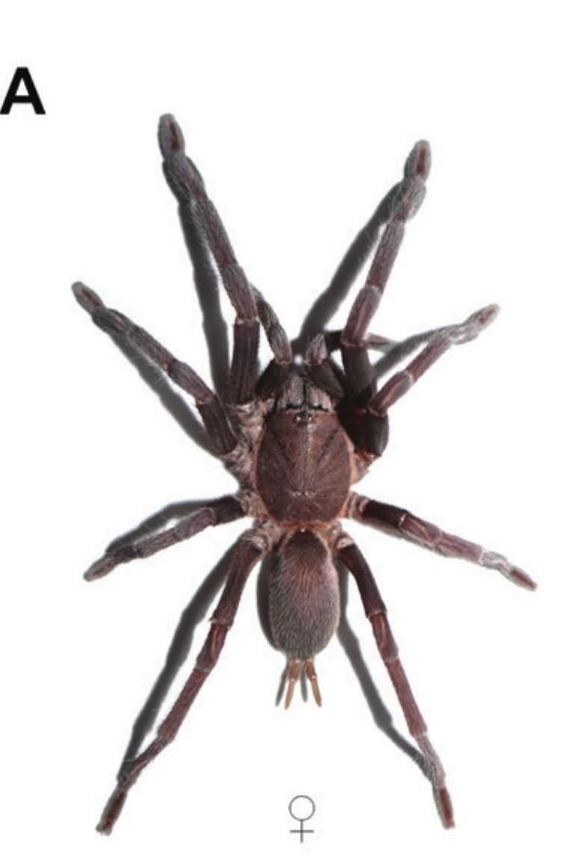 Female © Acuña et al. (2025), fig. 2A, dorsal habitus of a female
Type Locality and Records
Original Description
Distribution
Type Locality: PHILIPPINES, Luzon Island, Bicol Peninsula, Camarines Sur Province, Libmanan, 'Calapnitan Caves' [Culapnitan Caves], now within Libmanan Caves National Park
Adult Male Activity
Collection months of 2 adult male specimen records, against the rainfall where they live
Mean monthly rainfall and temperature 2001–2020 near the type locality. MERRA-2 via NASA POWER, for a grid cell averaging 10 m. Wet and dry seasons, from the rainfall at the locality itself.
Specimen Records (9)
Male syntype of Orphnaecus pellitus, re-examined by V. von Wirth. Collection date not stated; 1892 is the year of description.
Female syntypes of Orphnaecus pellitus. One re-examined by V. von Wirth; images of the second supplied by A.-E. Leguin.
Male portion of the Kalangkawan Cave lot UST-ARC 0031-0047 of Orphnaecus pellitus, collected in the dark zone. GenBank COI accessions for the Culapnitan material: PP778304-PP778306 and PP778313-PP778315 (non-types).
Four juveniles of Orphnaecus pellitus from Alinsanay Cave. The invasive cane toad Rhinella marina, a potential predator, was found inside the cave near the entrance.
Male portion of the Laya Cave lot UST-ARC 0052-0058 of Orphnaecus pellitus. Burrows shallow (to 15 cm), horizontal, laid with silk mats in guano substrate under limestone rocks.
Female portion of the Kalangkawan Cave lot UST-ARC 0031-0047 of Orphnaecus pellitus.
Juvenile portion of the Kalangkawan Cave lot UST-ARC 0031-0047 of Orphnaecus pellitus. Every life stage was found inside the cave system.
Female portion of the Laya Cave lot UST-ARC 0052-0058 of Orphnaecus pellitus.
Juvenile portion of the Laya Cave lot UST-ARC 0052-0058 of Orphnaecus pellitus.
Taxonomic History
- 1892 Orphnaecus pellitus Simon, 1892. Type species of Orphnaecus by monotypy. Rediscovered at its type locality and confirmed as a true troglobite by Acuña, Ragasa, Santiago-Bautista, von Wirth & Guevarra (2025), the first published troglobitic tarantula from Asia. A redescription is in preparation as part of an ongoing revision of the genus.