Abdomegaphobema mesomelas (O. Pickard-Cambridge, 1892)
Common name: Costa Rican Redleg
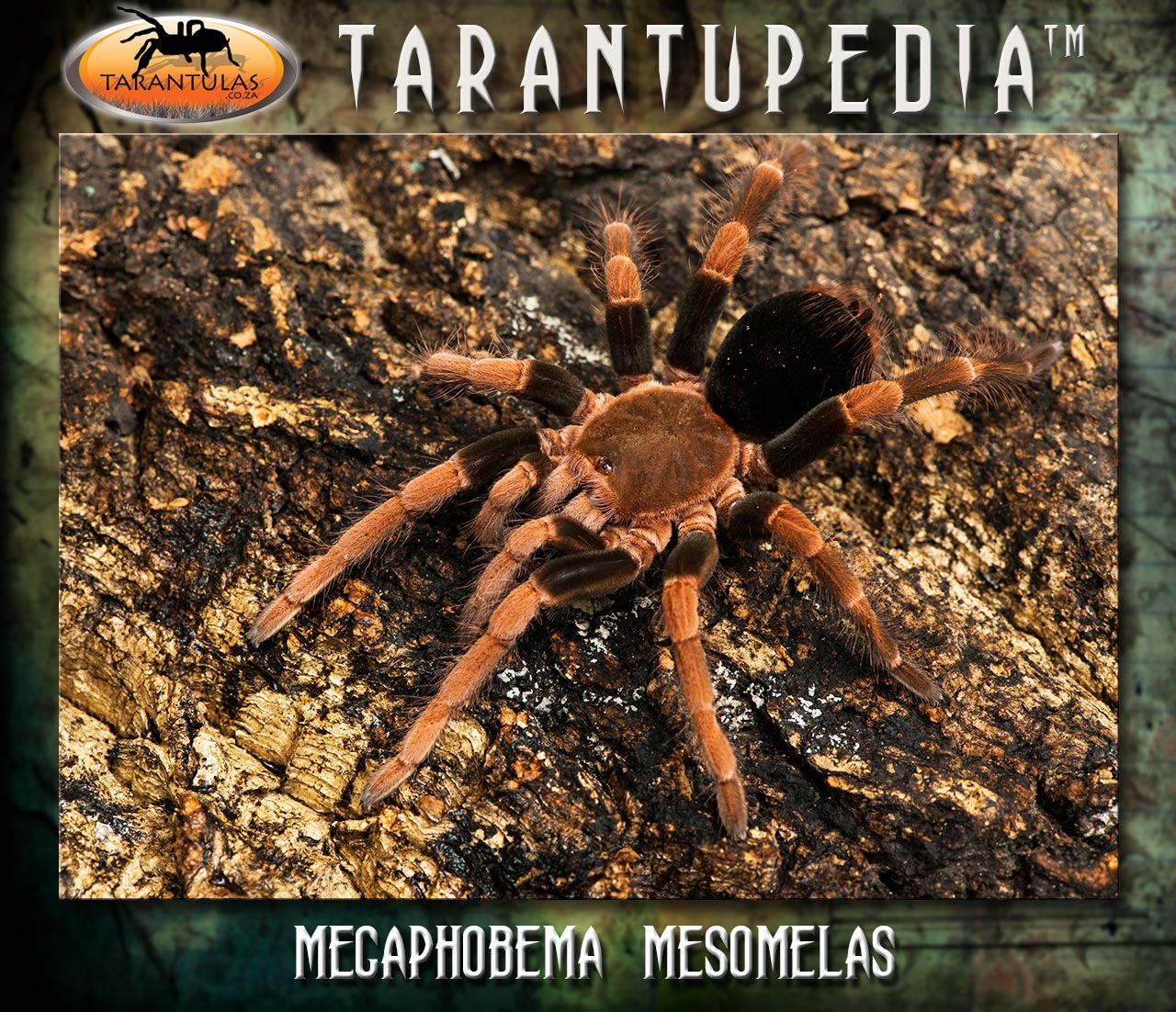 Female
Type Locality and Records
Original Description
Distribution
Type Locality: Costa Rica (Rogers). F. O. Pickard-Cambridge (1897) localises Rogers's material to Caché — Cachí, Cartago — and adds a second locality at La Palma, from a male sent by the Museo Nacional de Costa Rica and collected by J. F. Tristán.
Specimen Records (6)
Holotype male of Eurypelma mesomelas O. Pickard-Cambridge, 1892, in the Natural History Museum, London. Collected by Rogers; the original gives no locality finer than "Costa Rica". Its abdomen was opened and stuffed for preservation, which damaged the spinnerets and left Pickard-Cambridge unable to measure them. Re-examined by Sherwood et al. (2023) when the species was moved to Abdomegaphobema. Sherwood et al. (2023) examined it as "Rogers Coll. ex. dry collection".
Paratype female, same registration number as the holotype. Its abdomen has been eviscerated and the spermatheca is missing, so the female genitalia of this species remain undescribed (Sherwood et al. 2023) — the same preparation that cost Pickard-Cambridge the spinnerets in 1892.
Three adult males obtained by Rogers, reported by F. O. Pickard-Cambridge (1897) in the second Araneidea volume. The holotype of the species came from Rogers's material, so this is almost certainly the type locality, though the 1892 original gives nothing finer than "Costa Rica".
An adult male found at La Palma by J. F. Tristán and sent by the Museo Nacional de Costa Rica; the second locality known to F. O. Pickard-Cambridge (1897). Coordinates left blank — several places in Costa Rica carry the name.
Two non-type males of Abdomegaphobema mesomelas examined by Sherwood et al. (2023).
Two non-type males of Abdomegaphobema mesomelas from Cariblanco, examined by Sherwood et al. (2023).
Taxonomic History
- Abdomegaphobema mesomelas (O. Pickard-Cambridge, 1892) — type species of Abdomegaphobema Sherwood, Gabriel, Peñaherrera-R., León-E., Cisneros-Heredia, Brescovit & Lucas, 2023.
- This species has been shuffled through five genera in 130 years, with one transfer rejected along the way — and the first doubt about its placement was raised only five years after it was named.
- Described from a male as Eurypelma mesomelas in the Biologia Centrali-Americana, from material collected in Costa Rica by Rogers. Five years later the author's cousin, F. O. Pickard-Cambridge, treated it in the second Araneidea volume, localised Rogers's material to Caché and added a second from La Palma, and wrote that "it might be advisable to separate this species from Eurypelma, but at present I prefer to leave it in the group where it was first placed." Everything that followed was other people acting on that sentence.
- 1980 Valerio (1980) moved it to Brachypelma and added the female. Smith (1991a) transferred it to Euathlus — a move rejected in the same year by Schmidt (1991b), who placed it in Megaphobema instead; Smith nonetheless published a further treatment as Euathlus mesomelas the same year, and Schmidt restated the Megaphobema transfer in 1992. Megaphobema is where it stayed for three decades, through several of Schmidt's and Peters's handbooks, until Sherwood et al. (2023) erected Abdomegaphobema for it. Gabriel (2024) then explained the changes to a keeper audience.
- Two works in its bibliography carry health warnings from the catalogue itself: Peters (2003) is flagged by Longhorn & Gabriel (2019) as largely erroneous, and Smith (1986b) and (1987d) are two editions of one book.
- 2023 Sherwood et al. (2023) name the genus from the Latin abdo, to remove, and Megaphobema — for setting these two species aside from Megaphobema proper. They note that Ray Gabriel had recognised two genera within Megaphobema for more than fifteen years without publishing, waiting on a colleague who never did; Danniella Sherwood later examined the same material independently and reached the same conclusion.
- The genus is endemic to the cloud forest of San José, Alajuela and Guanacaste provinces, Costa Rica.