Acanthoscurria armasi
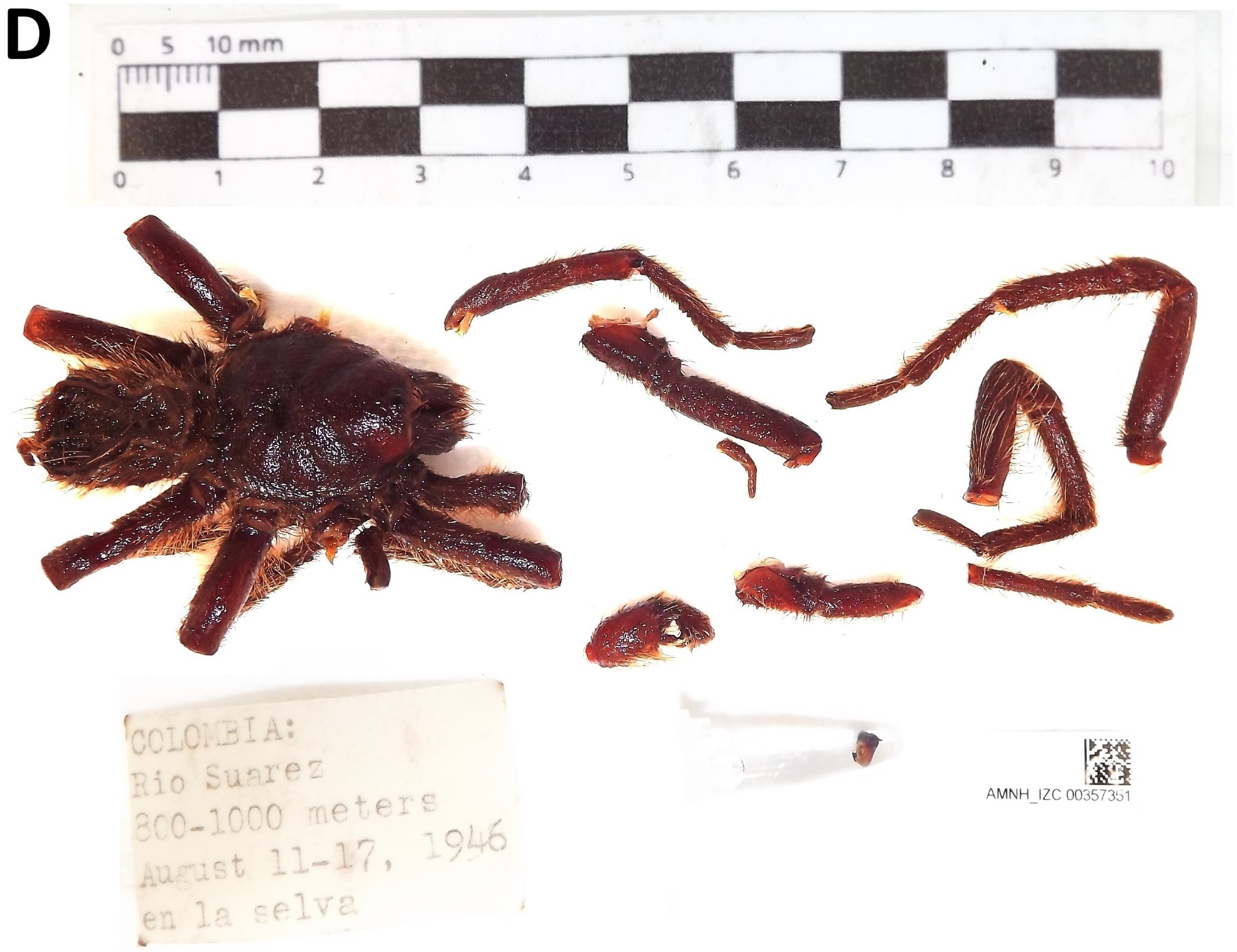 Male © Sherwood et al. (2025) fig. 2D — holotype male (AMNH_IZC00357351) in dorsal view with its original 1946 collection label, AMNH barcode and scale. The only specimen of the species. CC BY-NC 4.0
Type Locality and Records
Original Description
Distribution
Type Locality: Río Suarez, Colombia, 800-1000 m, en la selva
Adult Male Activity
Collection months of 1 adult male specimen record, against the rainfall where they live
Mean monthly rainfall and temperature 2001–2020 near where these males were collected, Colombia. MERRA-2 via NASA POWER, for a grid cell averaging 1708 m. Wet and dry seasons, from the rainfall at the locality itself.
Etymology
The specific epithet is a patronym in honour of Luis F. de Armas (Fundación Ariguanabo, and Institute of Ecology and Systematics, Cuba) in recognition of more than half a century of consistent research in arachnology, and to commemorate his 80th birthday.
Specimen Records (1)
Holotype male of Acanthoscurria armasi. Collected 11-17 August 1946; the label gives only the river and altitude, and the authors infer the Santander department from the altitudinal range, taking 6.3623844 -73.3434797 as a midpoint with a radius of about 3 km from the river.
Genitalia
Taxonomic History
- 2025 Acanthoscurria armasi Sherwood, Gabriel, Peñaherrera-R. & Alayón García, 2025 - described from a single male collected "en la selva" along the Río Suárez in Colombia in August 1946, which had been in the American Museum of Natural History for nearly eighty years. It is the first published record of Acanthoscurria from Colombia.
- The same paper erected the theraphosoides species-group for it and two long-established species, A. insubtilis Simon, 1892 and A. theraphosoides (Doleschall in Ausserer, 1871). Their males share a forward-pointing, finger-like apophysis on an unusually swollen palpal tibia, a single tibial apophysis on leg I, and a palpal bulb unlike anything else in the genus. The authors write that over more than a decade of work they have come to recognise five distinct lineages inside Acanthoscurria, held together only by the stridulation organ, and present this group as the first step towards separating them. Gabriel suspects some may prove to be a subfamily of their own.
- The paper also untangled the keels of these bulbs. The "subapical granular area" Bertani (2000) had noticed is shown to be a set of toothed keels on a swollen paraembolic apophysis - oblique in A. armasi and A. theraphosoides, transverse in A. insubtilis - and is put forward as a synapomorphy of the group. The keel that Bertani (2000) called apical, and that Paula et al. (2014) called the prolateral inferior keel, is reidentified as a prolateral accessory inferior keel.