Acanthoscurria belterrensis
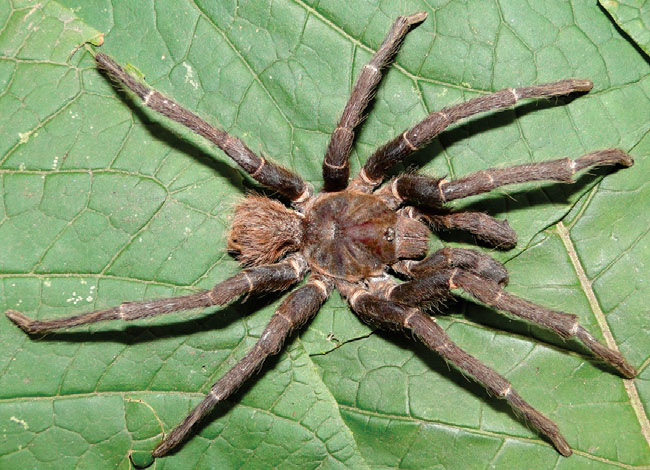 Male © Rafael P. Indicatti, in Paula et al. (2014) fig. 52 — the holotype male (IBSP 161719), a dead specimen photographed on a leaf. CC BY-NC
Type Locality and Records
Original Description
Distribution
Type Locality: Belterra, Floresta Nacional do Tapajós, Pará, Brazil
Adult Male Activity
Collection months of 5 adult male specimen records, against the rainfall where they live
All 5 were collected in February 2010, so the bars show when collecting took place, not when males are active.
Mean monthly rainfall and temperature 2001–2020 near where these males were collected, Brazil. MERRA-2 via NASA POWER, for a grid cell averaging 186 m. Wet and dry seasons, from the rainfall at the locality itself.
Etymology
Named after the type locality, Belterra, in the state of Pará.
Specimen Records (7)
Holotype male. Total length 36.6 mm. Figured by Paula et al. (2014) as fig. 52, photographed dead on a leaf, and for its palpal tibia, tibial apophysis and palpal bulb (figs 53-57). Caught in a 100-litre herpetological pitfall trap during a snake survey in February 2010 - every known specimen of the species came from that one campaign, so its date says when the traps were open, not when the spider is active.
Paratype male, same data as the holotype. Caught in a 100-litre herpetological pitfall trap during a snake survey in February 2010 - every known specimen of the species came from that one campaign, so its date says when the traps were open, not when the spider is active.
Paratype male, same data as the holotype. Caught in a 100-litre herpetological pitfall trap during a snake survey in February 2010 - every known specimen of the species came from that one campaign, so its date says when the traps were open, not when the spider is active.
Paratype male, same data as the holotype. Caught in a 100-litre herpetological pitfall trap during a snake survey in February 2010 - every known specimen of the species came from that one campaign, so its date says when the traps were open, not when the spider is active.
Paratype male, same data as the holotype. Faculdades Integradas do Tapajós, Santarém. Caught in a 100-litre herpetological pitfall trap during a snake survey in February 2010 - every known specimen of the species came from that one campaign, so its date says when the traps were open, not when the spider is active.
Paratype female, same data as the holotype. Faculdades Integradas do Tapajós, Santarém. Caught in a 100-litre herpetological pitfall trap during a snake survey in February 2010 - every known specimen of the species came from that one campaign, so its date says when the traps were open, not when the spider is active.
Paratype female, same data as the holotype. Total length 41.0 mm; its spermathecae are figured by Paula et al. (2014), figs 58-59. Caught in a 100-litre herpetological pitfall trap during a snake survey in February 2010 - every known specimen of the species came from that one campaign, so its date says when the traps were open, not when the spider is active.
Genitalia
Taxonomic History
- 2014 Acanthoscurria belterrensis Paula, Gabriel, Indicatti, Brescovit & Lucas, 2014 - described from five males and two females, all taken on 20 February 2010 in the Floresta Nacional do Tapajós at Belterra, Pará.
- It was the one new species in a revision of the Brazilian Amazonian Acanthoscurria. The same paper redescribed A. geniculata, A. tarda, A. juruenicola and A. theraphosoides; recorded A. simoensi and A. insubtilis from Brazil for the first time, describing both of their females for the first time; and sank four names - A. transamazonica into A. geniculata, A. ferina and A. brocklehursti into A. theraphosoides, and A. xinguensis into A. juruenicola.
- Nothing has been published on it since, and it is still known only from its type locality.