Acanthoscurria chacoana Brèthes, 1909
Common name: Bolivian Redrump
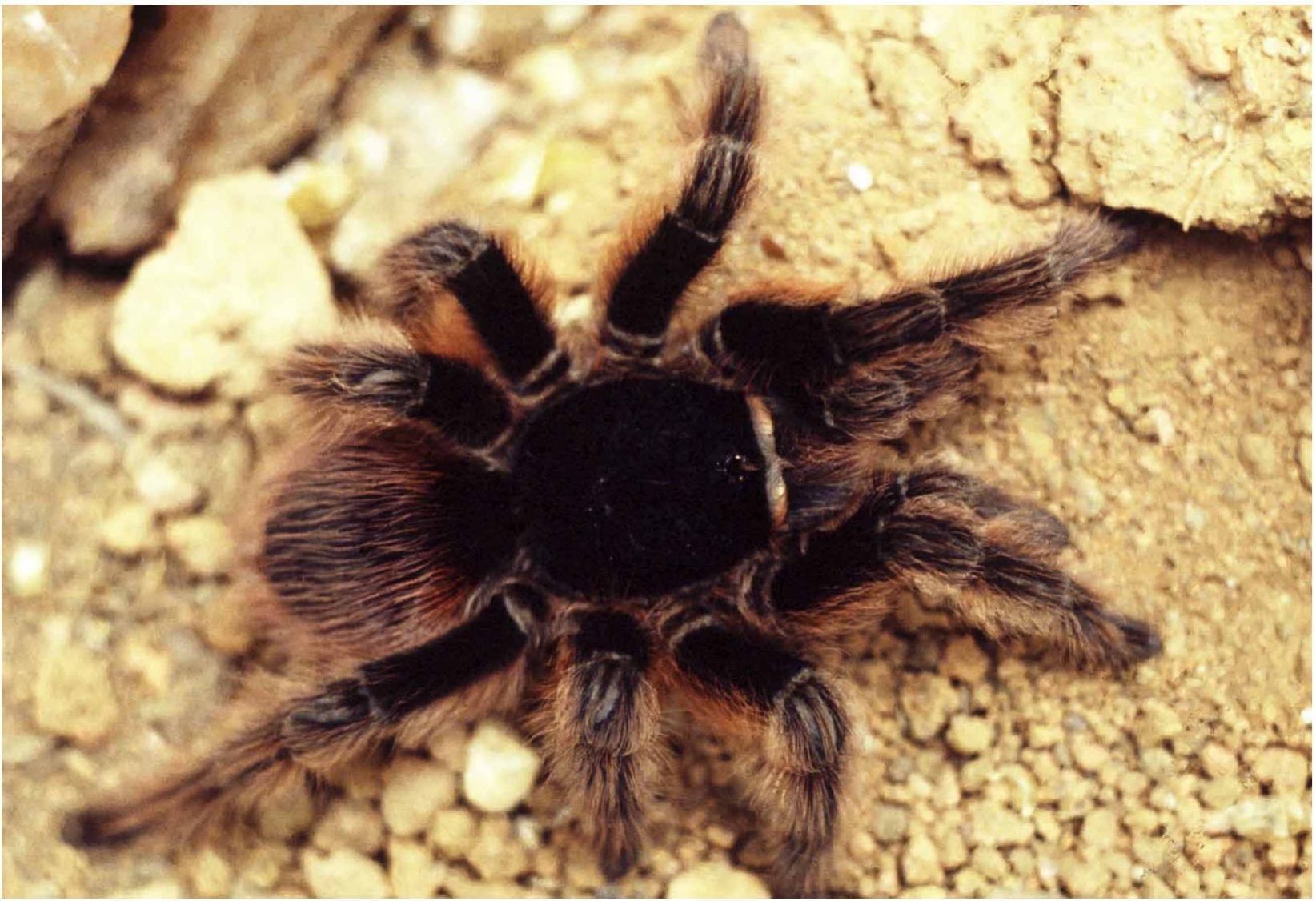 Live specimen © Rogério Bertani, in Bertani & Carla-da-Silva (2004) fig. 15 — a living female. Zootaxa 648, © 2004 Magnolia Press
Type Locality and Records
Original Description
Distribution
Type Locality: Tucumán, Argentina
Adult Male Activity
Collection months of 41 adult male specimen records, against the rainfall where they live
Of 41 adult males, 35 of 41 (85%) fall in the six wettest months, and 37 of 41 (90%) in the six warmest. Collections peak in December.
Mean monthly rainfall and temperature 2001–2020 near where these males were collected. MERRA-2 via NASA POWER, for a grid cell averaging 215 m. Southern hemisphere — seasons are inverted, so December is midsummer. Records span 3 countries (Argentina, Brazil, Paraguay), so one climate curve cannot describe all of them.
Etymology
Evidently for the Chaco, the great dry plain across northern Argentina, Paraguay and Bolivia, on whose western edge the type locality at Tucumán lies. Brèthes does not state the derivation.
Synonyms
Specimen Records (88)
Holotype female of Acanthoscurria altmanni, a synonym of A. chacoana; coll. Reichsteiner. Determined A. chacoana by R. Gabriel / A. Culmer, 5 August 2022. Coordinates are those of the town, geocoded from its name - not from the paper, which gives none.
Holotype female of Acanthoscurria chacoana, in the Museo Argentino de Ciencias Naturales "Bernardino Rivadavia", Buenos Aires - the "Museo Nacional" to which Salvador Mazza gave it. Brèthes (1909) gives only "Tucumán": no finer locality and no date, so none is entered. Carapace 23 x 19.5 mm. The catalogue number is from the MACN type catalogue of Galiano & Maury (1979), as cited by the World Spider Catalog. Coordinates are those of the town, geocoded from its name - not from the paper, which gives none.
Paratype female of Acanthoscurria altmanni, a synonym of A. chacoana; same data as the holotype. Coordinates are those of the town, geocoded from its name - not from the paper, which gives none.
Paratype male of Acanthoscurria altmanni, a synonym of A. chacoana; same data as the holotype. Coordinates are those of the town, geocoded from its name - not from the paper, which gives none.
Three males and two females; non-type material of Acanthoscurria chacoana, det. R. Gabriel 5 August 2022. Coordinates are those of Puerto Fonciere, geocoded from the name - not from the paper. The label gives the province as "Alto Paraguay", but the only Puerto Fonciere lies in Concepción department, on the Paraguay river.
Non-type material of Acanthoscurria chacoana; same data as NHMW 135. Coordinates are those of Puerto Fonciere, geocoded from the name - not from the paper. The label gives the province as "Alto Paraguay", but the only Puerto Fonciere lies in Concepción department, on the Paraguay river.
Examined by Bertani & Carla-da-Silva (2004), Instituto Butantan, São Paulo.
Examined by Bertani & Carla-da-Silva (2004), Instituto Butantan, São Paulo.
Examined by Bertani & Carla-da-Silva (2004), Instituto Butantan, São Paulo. Coordinates are those of the town, geocoded from its name - not from the paper, which gives none.
Examined by Bertani & Carla-da-Silva (2004), Instituto Butantan, São Paulo. Coordinates are those of the town, geocoded from its name - not from the paper, which gives none.
Examined by Bertani & Carla-da-Silva (2004), Instituto Butantan, São Paulo. Coordinates are those of the town, geocoded from its name - not from the paper, which gives none.
Examined by Bertani & Carla-da-Silva (2004), Instituto Butantan, São Paulo. Coordinates are those of the town, geocoded from its name - not from the paper, which gives none.
Examined by Bertani & Carla-da-Silva (2004), Instituto Butantan, São Paulo. Coordinates are those of the town, geocoded from its name - not from the paper, which gives none.
Examined by Bertani & Carla-da-Silva (2004), Instituto Butantan, São Paulo. Coordinates are those of the town, geocoded from its name - not from the paper, which gives none.
Examined by Bertani & Carla-da-Silva (2004), Instituto Butantan, São Paulo. Coordinates are those of the town, geocoded from its name - not from the paper, which gives none.
Examined by Bertani & Carla-da-Silva (2004), Instituto Butantan, São Paulo. Coordinates are those of the town, geocoded from its name - not from the paper, which gives none.
Examined by Bertani & Carla-da-Silva (2004), Instituto Butantan, São Paulo. Coordinates are those of the town, geocoded from its name - not from the paper, which gives none.
Examined by Bertani & Carla-da-Silva (2004), Instituto Butantan, São Paulo. Coordinates are those of the town, geocoded from its name - not from the paper, which gives none.
Examined by Bertani & Carla-da-Silva (2004), Instituto Butantan, São Paulo. Coordinates are those of the town, geocoded from its name - not from the paper, which gives none.
Examined by Bertani & Carla-da-Silva (2004), Instituto Butantan, São Paulo. Coordinates are those of the town, geocoded from its name - not from the paper, which gives none.
Non-type material of Acanthoscurria chacoana.
Examined by Bertani & Carla-da-Silva (2004), Instituto Butantan, São Paulo.
Examined by Bertani & Carla-da-Silva (2004), Instituto Butantan, São Paulo.
Examined by Bertani & Carla-da-Silva (2004), Instituto Butantan, São Paulo. Coordinates are those of the town, geocoded from its name - not from the paper, which gives none.
Examined by Bertani & Carla-da-Silva (2004), Instituto Butantan, São Paulo. Its spermathecae are fig. 11 of Bertani & Carla-da-Silva (2004). Coordinates are those of the town, geocoded from its name - not from the paper, which gives none.
Examined by Bertani & Carla-da-Silva (2004), Instituto Butantan, São Paulo. Coordinates are those of the town, geocoded from its name - not from the paper, which gives none.
Examined by Bertani & Carla-da-Silva (2004), Instituto Butantan, São Paulo. Coordinates are those of the town, geocoded from its name - not from the paper, which gives none.
Examined by Bertani & Carla-da-Silva (2004), Instituto Butantan, São Paulo. Coordinates are those of the town, geocoded from its name - not from the paper, which gives none.
Non-type female, Coleção Aracnológica do Instituto Butantan no. 3756. The specimen Stewien (1969) described as the female of "Acanthoscurria musculosa" - a misidentification of A. chacoana (Bertani & Carla-da-Silva, 2004). Total length 70.0 mm, carapace 27.0 x 25.5 mm, legs I 78.5, II 70.5, III 68.5, IV 81.5 mm. One of 25 Mato Grosso specimens in his study, 16 of them studied alive. Coordinates are those of the town, geocoded from its name - not from the paper, which gives none.
Examined by Bertani & Carla-da-Silva (2004), Instituto Butantan, São Paulo. Coordinates are those of the town, geocoded from its name - not from the paper, which gives none.
Examined by Bertani & Carla-da-Silva (2004), Instituto Butantan, São Paulo. Coordinates are those of the town, geocoded from its name - not from the paper, which gives none.
Examined by Bertani & Carla-da-Silva (2004), Instituto Butantan, São Paulo. Coordinates are those of the town, geocoded from its name - not from the paper, which gives none.
Examined by Bertani & Carla-da-Silva (2004), Instituto Butantan, São Paulo. Coordinates are those of the town, geocoded from its name - not from the paper, which gives none.
Examined by Bertani & Carla-da-Silva (2004), Instituto Butantan, São Paulo. Coordinates are those of the town, geocoded from its name - not from the paper, which gives none.
Examined by Bertani & Carla-da-Silva (2004), Instituto Butantan, São Paulo. Its spermathecae are fig. 10 of Bertani & Carla-da-Silva (2004). Coordinates are those of the town, geocoded from its name - not from the paper, which gives none.
Examined by Bertani & Carla-da-Silva (2004), Instituto Butantan, São Paulo. Coordinates are those of the town, geocoded from its name - not from the paper, which gives none.
Examined by Bertani & Carla-da-Silva (2004), Instituto Butantan, São Paulo. Coordinates are those of the town, geocoded from its name - not from the paper, which gives none.
Examined by Bertani & Carla-da-Silva (2004), Instituto Butantan, São Paulo.
Examined by Bertani & Carla-da-Silva (2004), Instituto Butantan, São Paulo. Coordinates are those of the town, geocoded from its name - not from the paper, which gives none.
Examined by Bertani & Carla-da-Silva (2004), Instituto Butantan, São Paulo. The paper lists "1 male, 1 female (IBSP 2032A)" - two animals under one number. Coordinates are those of the town, geocoded from its name - not from the paper, which gives none.
Examined by Bertani & Carla-da-Silva (2004), Instituto Butantan, São Paulo. Coordinates are those of the town, geocoded from its name - not from the paper, which gives none.
Examined by Bertani & Carla-da-Silva (2004), Instituto Butantan, São Paulo. Coordinates are those of the town, geocoded from its name - not from the paper, which gives none.
Examined by Bertani & Carla-da-Silva (2004), Instituto Butantan, São Paulo. Coordinates are those of the town, geocoded from its name - not from the paper, which gives none.
Examined by Bertani & Carla-da-Silva (2004), Instituto Butantan, São Paulo. Its palpal bulb is figs 5-6 of Bertani & Carla-da-Silva (2004). Coordinates are those of the town, geocoded from its name - not from the paper, which gives none.
Examined by Bertani & Carla-da-Silva (2004), Instituto Butantan, São Paulo. Coordinates are those of the town, geocoded from its name - not from the paper, which gives none.
Examined by Bertani & Carla-da-Silva (2004), Instituto Butantan, São Paulo. Coordinates are those of the town, geocoded from its name - not from the paper, which gives none.
Examined by Bertani & Carla-da-Silva (2004), Instituto Butantan, São Paulo. Coordinates are those of the town, geocoded from its name - not from the paper, which gives none.
Examined by Bertani & Carla-da-Silva (2004), Instituto Butantan, São Paulo. Its spermathecae are fig. 12 of Bertani & Carla-da-Silva (2004). Coordinates are those of the town, geocoded from its name - not from the paper, which gives none.
Examined by Bertani & Carla-da-Silva (2004), Instituto Butantan, São Paulo. Coordinates are those of the town, geocoded from its name - not from the paper, which gives none.
Examined by Bertani & Carla-da-Silva (2004), Instituto Butantan, São Paulo. Coordinates are those of the town, geocoded from its name - not from the paper, which gives none.
Examined by Bertani & Carla-da-Silva (2004), Instituto Butantan, São Paulo. Coordinates are those of the town, geocoded from its name - not from the paper, which gives none.
Examined by Bertani & Carla-da-Silva (2004), Instituto Butantan, São Paulo.
Examined by Bertani & Carla-da-Silva (2004), Instituto Butantan, São Paulo.
Examined by Bertani & Carla-da-Silva (2004), Instituto Butantan, São Paulo. Coordinates are those of the town, geocoded from its name - not from the paper, which gives none.
Examined by Bertani & Carla-da-Silva (2004), Instituto Butantan, São Paulo. Coordinates are those of the town, geocoded from its name - not from the paper, which gives none.
Examined by Bertani & Carla-da-Silva (2004), Instituto Butantan, São Paulo. Coordinates are those of the town, geocoded from its name - not from the paper, which gives none.
Examined by Bertani & Carla-da-Silva (2004), Instituto Butantan, São Paulo. Coordinates are those of the town, geocoded from its name - not from the paper, which gives none.
Examined by Bertani & Carla-da-Silva (2004), Instituto Butantan, São Paulo. Coordinates are those of the town, geocoded from its name - not from the paper, which gives none.
Examined by Bertani & Carla-da-Silva (2004), Instituto Butantan, São Paulo. Coordinates are those of the town, geocoded from its name - not from the paper, which gives none.
Examined by Bertani & Carla-da-Silva (2004), Instituto Butantan, São Paulo. Coordinates are those of the town, geocoded from its name - not from the paper, which gives none.
Examined by Bertani & Carla-da-Silva (2004), Instituto Butantan, São Paulo. Its palpal bulb is figs 7-8 of Bertani & Carla-da-Silva (2004). Coordinates are those of the town, geocoded from its name - not from the paper, which gives none.
Examined by Bertani & Carla-da-Silva (2004), Instituto Butantan, São Paulo. Coordinates are those of the town, geocoded from its name - not from the paper, which gives none.
Examined by Bertani & Carla-da-Silva (2004), Instituto Butantan, São Paulo. Coordinates are those of the town, geocoded from its name - not from the paper, which gives none.
Examined by Bertani & Carla-da-Silva (2004), Instituto Butantan, São Paulo. Coordinates are those of the town, geocoded from its name - not from the paper, which gives none.
Examined by Bertani & Carla-da-Silva (2004), Instituto Butantan, São Paulo. Coordinates are those of the town, geocoded from its name - not from the paper, which gives none.
Examined by Bertani & Carla-da-Silva (2004), Instituto Butantan, São Paulo. Coordinates are those of the town, geocoded from its name - not from the paper, which gives none.
Examined by Bertani & Carla-da-Silva (2004), Instituto Butantan, São Paulo. Coordinates are those of the town, geocoded from its name - not from the paper, which gives none.
Examined by Bertani & Carla-da-Silva (2004), Instituto Butantan, São Paulo. Coordinates are those of the town, geocoded from its name - not from the paper, which gives none.
Examined by Bertani & Carla-da-Silva (2004), Instituto Butantan, São Paulo. Listed as a female in the paper's material examined, but figs 3-4 of the same paper are the palpal bulb of a male "(IBSP 7559), Brazil, Mato Grosso, Cáceres". The paper contradicts itself; recorded here as listed. Coordinates are those of the town, geocoded from its name - not from the paper, which gives none.
Examined by Bertani & Carla-da-Silva (2004), Instituto Butantan, São Paulo. One of eleven males taken in December 1997. Coordinates are those of the town, geocoded from its name - not from the paper, which gives none.
Examined by Bertani & Carla-da-Silva (2004), Instituto Butantan, São Paulo. One of eleven males taken in December 1997. Coordinates are those of the town, geocoded from its name - not from the paper, which gives none.
Examined by Bertani & Carla-da-Silva (2004), Instituto Butantan, São Paulo. One of eleven males taken in December 1997. Coordinates are those of the town, geocoded from its name - not from the paper, which gives none.
Examined by Bertani & Carla-da-Silva (2004), Instituto Butantan, São Paulo. One of eleven males taken in December 1997. Coordinates are those of the town, geocoded from its name - not from the paper, which gives none.
Examined by Bertani & Carla-da-Silva (2004), Instituto Butantan, São Paulo. One of eleven males taken in December 1997. Coordinates are those of the town, geocoded from its name - not from the paper, which gives none.
Examined by Bertani & Carla-da-Silva (2004), Instituto Butantan, São Paulo. One of eleven males taken in December 1997. Coordinates are those of the town, geocoded from its name - not from the paper, which gives none.
Examined by Bertani & Carla-da-Silva (2004), Instituto Butantan, São Paulo. One of eleven males taken in December 1997. Coordinates are those of the town, geocoded from its name - not from the paper, which gives none.
Examined by Bertani & Carla-da-Silva (2004), Instituto Butantan, São Paulo. One of eleven males taken in December 1997. Coordinates are those of the town, geocoded from its name - not from the paper, which gives none.
Examined by Bertani & Carla-da-Silva (2004), Instituto Butantan, São Paulo. One of eleven males taken in December 1997. Coordinates are those of the town, geocoded from its name - not from the paper, which gives none.
Examined by Bertani & Carla-da-Silva (2004), Instituto Butantan, São Paulo. One of eleven males taken in December 1997. Coordinates are those of the town, geocoded from its name - not from the paper, which gives none.
Examined by Bertani & Carla-da-Silva (2004), Instituto Butantan, São Paulo. One of eleven males taken in December 1997. Coordinates are those of the town, geocoded from its name - not from the paper, which gives none.
Examined by Bertani & Carla-da-Silva (2004), Instituto Butantan, São Paulo. Coordinates are those of the town, geocoded from its name - not from the paper, which gives none.
Examined by Bertani & Carla-da-Silva (2004), Instituto Butantan, São Paulo. Coordinates are those of the town, geocoded from its name - not from the paper, which gives none.
One immature; non-type material of Acanthoscurria chacoana.
Non-type material of Acanthoscurria chacoana examined by Sherwood et al. (2025).
Three males; non-type material of Acanthoscurria chacoana. Coordinates are those of the town, geocoded from its name - not from the paper, which gives none.
Non-type female of Acanthoscurria chacoana, det. R. Gabriel 27 October 2023.
The male Schiapelli & Gerschman (1964) described as the first male of Acanthoscurria chacoana, in the Museo Argentino de Ciencias Naturales, Buenos Aires. Re-examined, and its palpal bulb figured, by Bertani & Carla-da-Silva (2004) figs 1-2. No date recorded.
The male Mello-Leitão (1923) described under the name Acanthoscurria musculosa, in the Museu de Zoologia da Universidade de São Paulo. Bertani & Carla-da-Silva (2004) examined it and showed it to be A. chacoana. Stewien (1969) says Mello-Leitão's males came from Cáceres, Mato Grosso. No date recorded. Coordinates are those of the town, geocoded from its name - not from the paper, which gives none.
Genitalia
Taxonomic History
- 1909 Acanthoscurria chacoana Brèthes, 1909 - described from one female from Tucumán, Argentina, which Salvador Mazza gave to the Museo Nacional de Buenos Aires. The holotype is MACN 5659 (Galiano & Maury, 1979).
- 1923 Mello-Leitão (1923) figured a male of this species under the name A. musculosa - a misidentification, as Bertani & Carla-da-Silva (2004) later showed.
- 1964 Schiapelli & Gerschman (1964), revising the Acanthoscurria of Argentina, described the male for the first time.
- 1969 Stewien (1969) published what he took to be the first female of A. musculosa; it too was A. chacoana.
- 2003 Schmidt (2003) described Acanthoscurria altmanni as a new species from Cuiabá, Mato Grosso - "a long-known double of Nhandu carapoensis" - and described its male later the same year.
- 2004 Bertani & Carla-da-Silva (2004) examined the holotypes of both A. chacoana and A. musculosa, Mello-Leitão's male and Stewien's female, and some seventy specimens from Mato Grosso, Mato Grosso do Sul and Bolivia. They extended the species into Brazil, showed that its palpal bulb and spermathecae vary widely within and between populations, and made A. altmanni a junior synonym. They did so without seeing the altmanni holotype, reasoning instead from topotypic material, from Schmidt's own drawings of its spermathecae, and from his photograph of a living altmanni, which matches A. chacoana.
- The catalogue records two different holotypes for A. altmanni: a female exuvia in the Senckenberg (SMF 40572-84, with a paratype exuvia, from a 2019 database search) and a female in Vienna (NHMW 21178, with a male and a female paratype, per Sherwood et al., 2025). A name has one holotype; nothing available here resolves which is right.