Acanthoscurria insubtilis Simon, 1892
Common name: Bolivian black velvet
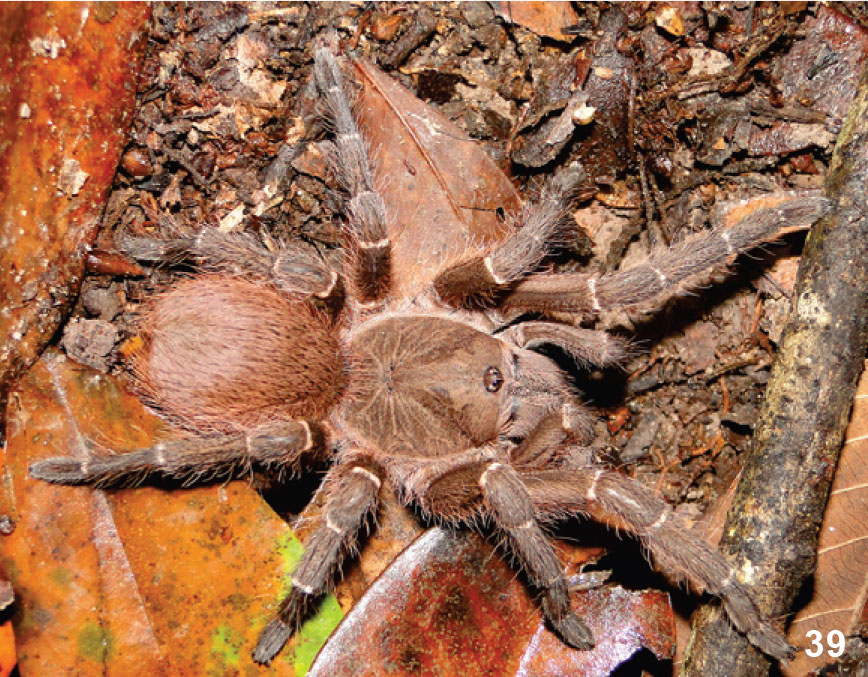 Female © Rafael P. Indicatti, in Paula et al. (2014) fig. 39 - a living female from Mutum, Porto Velho, Rondônia (MZSP 44493). Zoologia 31(1), CC BY-NC
Type Locality and Records
Original Description
Distribution
Type Locality: San Mateo, Cochabamba, Bolivia ("Bolivia: San-Mateo", Garlepp)
Adult Male Activity
Collection months of 13 adult male specimen records, against the rainfall where they live
Of 13 adult males, 9 of 13 (69%) fall in the six wettest months, and 9 of 13 (69%) in the six warmest. Collections peak in November.
Mean monthly rainfall and temperature 2001–2020 near where these males were collected. MERRA-2 via NASA POWER, for a grid cell averaging 136 m. Wet and dry seasons, from the rainfall at the locality itself. Records span 2 countries (Bolivia, Brazil), so one climate curve cannot describe all of them.
Etymology
Latin insubtilis, "not fine" - coarse or unrefined, the opposite of subtilis. Simon does not explain the name.
Synonyms
Specimen Records (46)
Holotype male of Acanthoscurria insubtilis Simon, 1892; E. Simon collection no. 15132. Simon gives only "Bolivia: San-Mateo (Garlepp)"; Garlepp collected widely around San Mateo in the Cochabamba yungas (Lourenço & Leguin 2011, cited by Paula et al. 2014). Coordinates are the San Mateo (Ivirizu) valley, approximate. Its bulb is fig. 3 of Sherwood et al. (2025), the model for their naming of the keels.
Lectotype and paralectotype females of Crypsidromus bolivianus Simon, 1892, designated by Bertani (2023), a junior synonym of A. insubtilis; E. Simon collection no. 15135. Coordinates are the Espíritu Santo river in the Chapare, approximate.
Examined by Paula et al. (2014).
Examined by Paula et al. (2014).
Examined by Paula et al. (2014).
Examined by Paula et al. (2014).
Examined by Paula et al. (2014).
Examined by Paula et al. (2014).
Examined by Paula et al. (2014). Coordinates as given in the paper, which uses one point (Porto Velho) for all these localities.
Examined by Paula et al. (2014).
One of six females collected January-May 1989 by the Equipe Resgate de Fauna during the filling of the Samuel dam. Examined by Paula et al. (2014). Coordinates as given in the paper, which uses one point (Porto Velho) for all these localities.
One of six females collected January-May 1989 by the Equipe Resgate de Fauna during the filling of the Samuel dam. The female Paula et al. (2014) described, and whose spermathecae are figs 47-48. Examined by Paula et al. (2014). Coordinates as given in the paper, which uses one point (Porto Velho) for all these localities.
One of six females collected January-May 1989 by the Equipe Resgate de Fauna during the filling of the Samuel dam. Examined by Paula et al. (2014). Coordinates as given in the paper, which uses one point (Porto Velho) for all these localities.
One of six females collected January-May 1989 by the Equipe Resgate de Fauna during the filling of the Samuel dam. Examined by Paula et al. (2014). Coordinates as given in the paper, which uses one point (Porto Velho) for all these localities.
One of six females collected January-May 1989 by the Equipe Resgate de Fauna during the filling of the Samuel dam. The paper lists this number among the females but describes and figures it as a male (figs 42-46); the sex here follows the list. Examined by Paula et al. (2014). Coordinates as given in the paper, which uses one point (Porto Velho) for all these localities.
One of six females collected January-May 1989 by the Equipe Resgate de Fauna during the filling of the Samuel dam. Examined by Paula et al. (2014). Coordinates as given in the paper, which uses one point (Porto Velho) for all these localities.
One of six males collected January-May 1989 by the Equipe Resgate de Fauna during the filling of the Samuel dam. Examined by Paula et al. (2014). Coordinates as given in the paper, which uses one point (Porto Velho) for all these localities.
One of six males collected January-May 1989 by the Equipe Resgate de Fauna during the filling of the Samuel dam. Examined by Paula et al. (2014). Coordinates as given in the paper, which uses one point (Porto Velho) for all these localities.
One of six males collected January-May 1989 by the Equipe Resgate de Fauna during the filling of the Samuel dam. Examined by Paula et al. (2014). Coordinates as given in the paper, which uses one point (Porto Velho) for all these localities.
One of six males collected January-May 1989 by the Equipe Resgate de Fauna during the filling of the Samuel dam. Examined by Paula et al. (2014). Coordinates as given in the paper, which uses one point (Porto Velho) for all these localities.
One of six males collected January-May 1989 by the Equipe Resgate de Fauna during the filling of the Samuel dam. Examined by Paula et al. (2014). Coordinates as given in the paper, which uses one point (Porto Velho) for all these localities.
One of six males collected January-May 1989 by the Equipe Resgate de Fauna during the filling of the Samuel dam. Examined by Paula et al. (2014). Coordinates as given in the paper, which uses one point (Porto Velho) for all these localities.
Examined by Paula et al. (2014).
Examined by Paula et al. (2014). Coordinates as given in the paper, which uses one point (Porto Velho) for all these localities.
Five females, collected 6-15.VII.2001. Examined by Paula et al. (2014).
Examined by Paula et al. (2014).
Non-type male, Oxford University Museum 2004-005; coordinates from Paula et al. (2014).
The paper places this on the Transpantaneira, the Pantanal road south of Poconé (about 16-17°S), but gives coordinates of 11°43'S, far to the north; entered as given. Examined by Paula et al. (2014).
Examined by Paula et al. (2014). Coordinates as given in the paper, which uses one point (Porto Velho) for all these localities.
One female and one juvenile under this number. Examined by Paula et al. (2014). Coordinates as given in the paper, which uses one point (Porto Velho) for all these localities.
Examined by Paula et al. (2014). Coordinates as given in the paper, which uses one point (Porto Velho) for all these localities.
Examined by Paula et al. (2014). Coordinates as given in the paper, which uses one point (Porto Velho) for all these localities.
Examined by Paula et al. (2014). Coordinates as given in the paper, which uses one point (Porto Velho) for all these localities.
Examined by Paula et al. (2014). Coordinates as given in the paper, which uses one point (Porto Velho) for all these localities.
Examined by Paula et al. (2014).
Examined by Paula et al. (2014).
The female photographed alive for figs 39-40 (the photograph on this page). Examined by Paula et al. (2014).
Examined by Paula et al. (2014).
Examined by Paula et al. (2014).
The male photographed alive for fig. 38 (the photograph on this page). Examined by Paula et al. (2014).
Examined by Paula et al. (2014).
Examined by Paula et al. (2014).
Examined by Paula et al. (2014).
Examined by Paula et al. (2014).
Examined by Paula et al. (2014).
Examined by Paula et al. (2014).
Genitalia
Taxonomic History
- 1892 Acanthoscurria insubtilis Simon, 1892 - described from a single male from San Mateo, Bolivia, collected by G. Garlepp (MNHN AR 4784). In the same paper Simon described Crypsidromus bolivianus from females from Espíritu Santo, Bolivia, also Garlepp's.
- 1954 Ibarra (1954) described Acanthoscurria abnormis from a male from Bolivia.
- 1964 Schiapelli & Gerschman (1964) redescribed the male and made A. abnormis a junior synonym.
- 2000 Bertani (2000) figured its palpal bulb in his survey of the keels of the theraphosine bulb.
- 2014 Paula et al. (2014) described the female for the first time and recorded the species from Brazil for the first time, in Acre, Amazonas, Rondônia, Mato Grosso and Mato Grosso do Sul.
- 2023 Bertani (2023), revising Lasiodora, designated a lectotype for Crypsidromus bolivianus - long carried as Lasiodora boliviana - and made it a junior synonym.
- 2025 Sherwood et al. (2025) placed the species in their new theraphosoides species-group and used the holotype's bulb as the model for naming the group's keels.