Aguapanela arvi
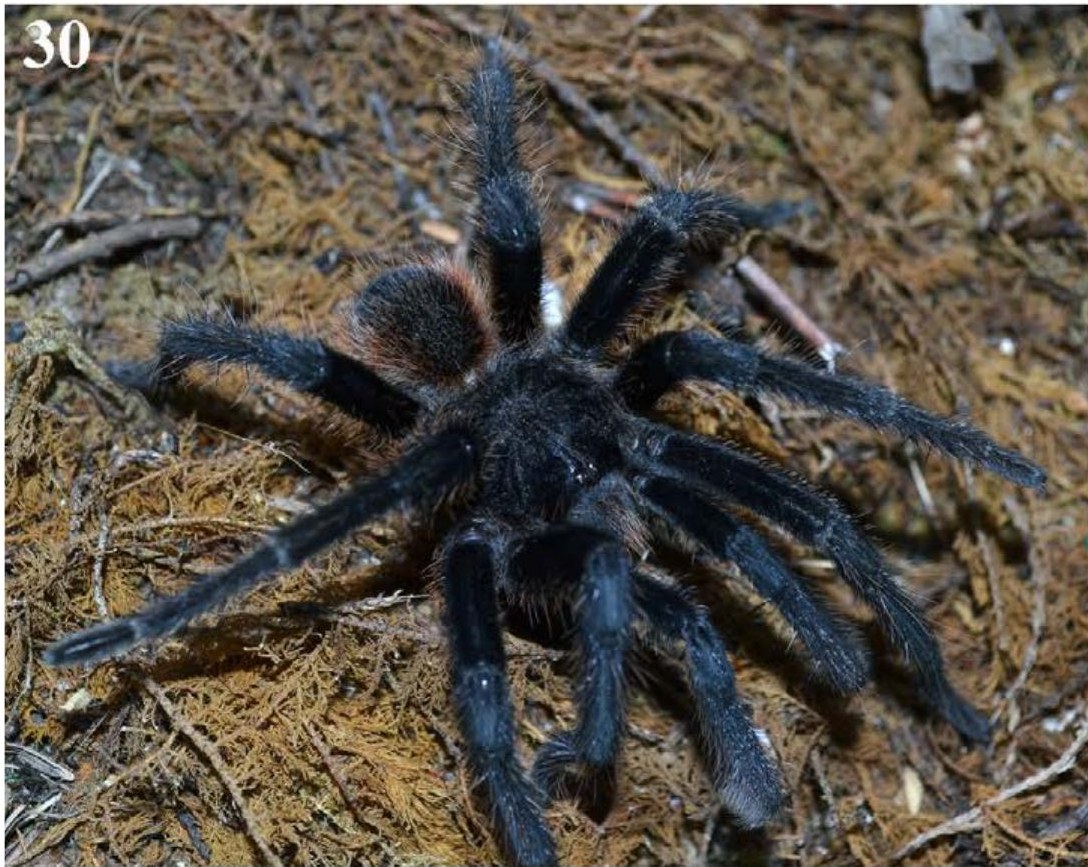 Live specimen © Perafán, Cifuentes & Estrada (2015, fig. 30) — holotype male alive, habitus
Type Locality and Records
Original Description
Distribution
Type Locality: Colombia, Antioquia: holotype male (ICN-Ar 7914), Medellín, Corregimiento Santa Elena, Piedras Blancas Ecological Park, 2400 masl, 18 October 2013
Adult Male Activity
Collection months of 5 adult male specimen records, against the rainfall where they live
Of 5 adult males, 1 of 5 (20%) fall in the six wettest months, and 2 of 5 (40%) in the six warmest. Collections peak in February.
Mean monthly rainfall and temperature 2001–2020 near where these males were collected, Colombia. MERRA-2 via NASA POWER, for a grid cell averaging 2472 m. Wet and dry seasons, from the rainfall at the locality itself.
Etymology
The specific epithet is a noun in apposition taken from the locality where the holotype was found. Arvi means place with a very rich area in natural resources in a native indigenous language
Specimen Records (11)
Holotype male of Aguapanela arvi, and so the name-bearing type of the genus. Total length 27 mm excluding chelicerae and spinnerets. Source of the palpal bulb figures and of the live habitus photograph.
Allotype female of Aguapanela arvi, same data as the holotype. Source of the spermathecae figure and of the live female habitus photograph.
Three paratype females of Aguapanela arvi, same data as the holotype.
One male and one female of Aguapanela arvi. The locality is the municipality of Caldas in Antioquia, not the department of Caldas — Perafán et al. (2015) list it among "Caldas cities" in Antioquia. Coordinates are for the municipality and are approximate.
Non-type male of Aguapanela arvi, listed as additional material examined by Perafán et al. (2015).
Non-type male of Aguapanela arvi, listed as additional material examined by Perafán et al. (2015).
Male of Aguapanela arvi, direct capture. Among the first records of the species from Risaralda.
Female of Aguapanela arvi, direct capture.
Female of Aguapanela arvi from Risaralda, one of the records establishing the species in that department for the first time.
Male of Aguapanela arvi from Risaralda, collected with CUS-E Ar-10.
Female of Aguapanela arvi, the highest of the Risaralda records at 2327 m.
Genitalia
Taxonomic History
- 2015 Aguapanela arvi Perafán, Cifuentes & Estrada, 2015 — type species and only member of Aguapanela Perafán, Cifuentes & Estrada, 2015.
- The genus name is a noun in apposition for the sugarcane drink of the northern Andes; the species is named for Arví, the type locality, from an indigenous word for a place rich in natural resources.
- 2026 Aguirre-Cano et al. (2026) extended the range from Antioquia alone to four departments — adding Caldas, Quindío and Risaralda — using museum material, field observation and iNaturalist records. Note that the 2015 paper already lists material from "Caldas"; that is the municipality of Caldas in Antioquia, not the department of the same name, which is why the department can still be reported as new.
- The 2026 paper also adds two natural enemies: a spider-hunting wasp (Pompilidae) photographed attacking an individual, and an arthropod-pathogenic fungus, Cordyceps cf. caloceroides, growing from another.