Bermejoa panguana
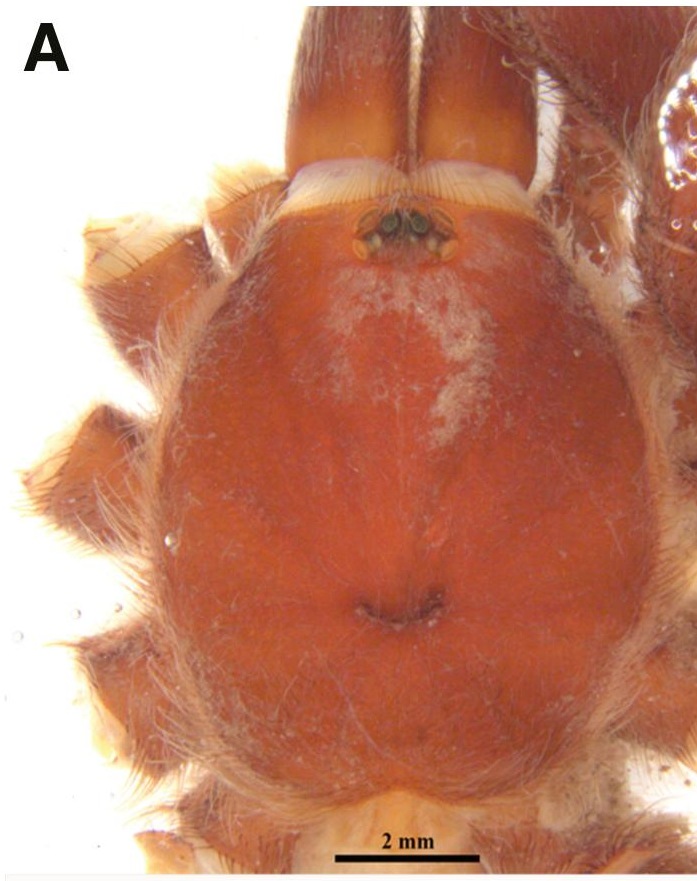 Carapace © Portela & Ríos-Tamayo (2025, fig. 1A) — holotype male SMNK-ARA 19499
Type Locality and Records
Original Description
Distribution
Type Locality: PERU: Huánuco, Puerto Inca, Panguana Biological Station (Río Yuyapichis), 260 m
Adult Male Activity
Collection months of 1 adult male specimen record, against the rainfall where they live
Mean monthly rainfall and temperature 2001–2020 near where these males were collected, Peru. MERRA-2 via NASA POWER, for a grid cell averaging 205 m. Wet and dry seasons, from the rainfall at the locality itself.
Etymology
A noun in apposition referring to the type locality, the "Panguana" Biological Research Station on the Río Yuyapichis.
Specimen Records (3)
Holotype male of Bermejoa panguana; pitfall trap, 21 January - 18 February 1984 (field label BF VI CC 4)
Paratype female of Bermejoa panguana and the described female — the first female known in the genus; pitfall trap, 26 November - 24 December 1983 (field label BF KI Cb7)
Remaining paratype series of Bermejoa panguana: roughly 22 males and 5 females across 17 lots, all pitfall-trapped between 26 November 1983 and 18 February 1984, plus a series of immatures listed as non-type material
Genitalia
Taxonomic History
- 2025 Bermejoa panguana Portela & Ríos-Tamayo, 2025
- Only the second species of Bermejoa, which Gabriel, Sherwood & Pérez-Miles erected in 2023 for a single male from Santa Cruz, Bolivia. This is the first record of the genus from Peru and the first description of a female in the genus.