Bonnetina aviae
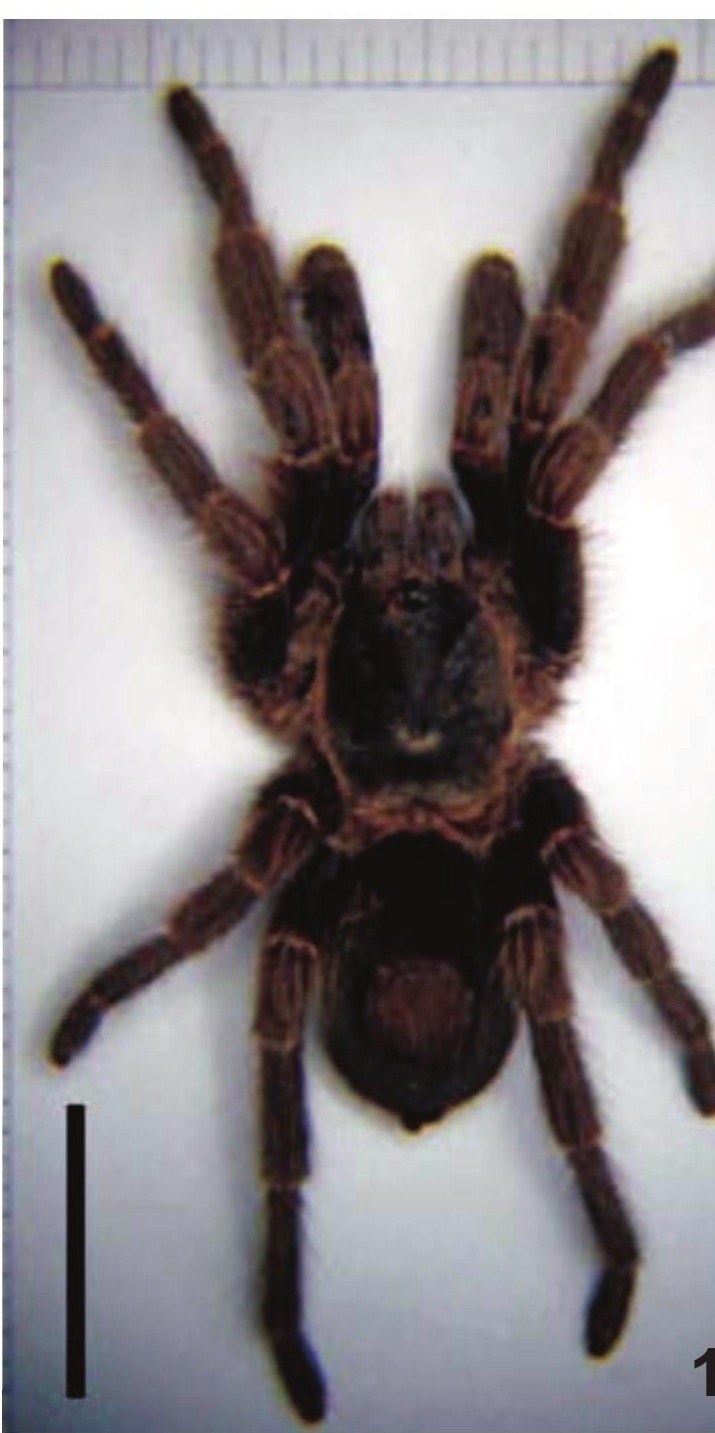 Male © Estrada-Álvarez & Locht (2011, fig. 1) — holotype male CNAN-T0693, dorsal. Scale bar 10 mm
Type Locality and Records
Original Description
Distribution
Type Locality: México: Ecatepec de Morelos, Colonia San Cristóbal, Panteón San Efrén; Estado de México (N 19°35.45': W 99°02.75')
Adult Male Activity
Collection months of 2 adult male specimen records, against the rainfall where they live
All 2 were collected in January 2009, so the bars show when collecting took place, not when males are active.
Mean monthly rainfall and temperature 2001–2020 near where these males were collected, Mexico. MERRA-2 via NASA POWER, for a grid cell averaging 2228 m. Wet and dry seasons, from the rainfall at the locality itself.
Etymology
Latin "avia" grandmother; plural "aviae" grandmothers. Named in memory of our grandmothers.
Specimen Records (3)
Holotype male of Bonnetina aviae. Figured in dorsal view and as the source of the palpal bulb, ocular tubercle and tibia I figures (figs 1-8). The three spines of the right retrolateral tibial apophysis were removed for study and so do not appear in fig. 6.
Two paratype males of Bonnetina aviae. Total length across the three males ranges 15.16-18.74 mm, mean 16.80, the holotype being the largest. The paratypes differ from the holotype in the number of spines on the retrolateral tibial apophysis: one a side in the first, two and three in the second, against three a side in the holotype.
Two paratype females of Bonnetina aviae. The female description and the measurement and chaetotaxy tables are based on ♀1 (17.34 mm); ♀2 (19.05 mm) had moulted shortly before dissection, which the authors use to explain her softer, flatter and apparently wider spermatheca. Both spermathecae are figured (figs 10-11).
Genitalia
Taxonomic History
- 2011 Bonnetina aviae Estrada-Álvarez & Locht, 2011
- The fourth species of Bonnetina, and the one that broke the genus out of the Pacific slope: the types came from the San Efrén cemetery in Ecatepec de Morelos on the northern edge of Mexico City, while the three species described before it were from Colima, Michoacán and Morelos.
- The description closes with a key to all four species then known. The key is unreliable on its own terms — several couplets cite the wrong figure numbers, and it credits B. alagoni with nine teeth on the cheliceral promargin where the diagnosis on the paper's first page gives that species eight. The paper does not resolve the contradiction.
- The name still stands. Of the four species covered by that key, B. rudloffi has since been treated as a junior synonym, as has B. reyescastilloi, described later by the first author; B. aviae remains valid.