Euathlus ameghinoi
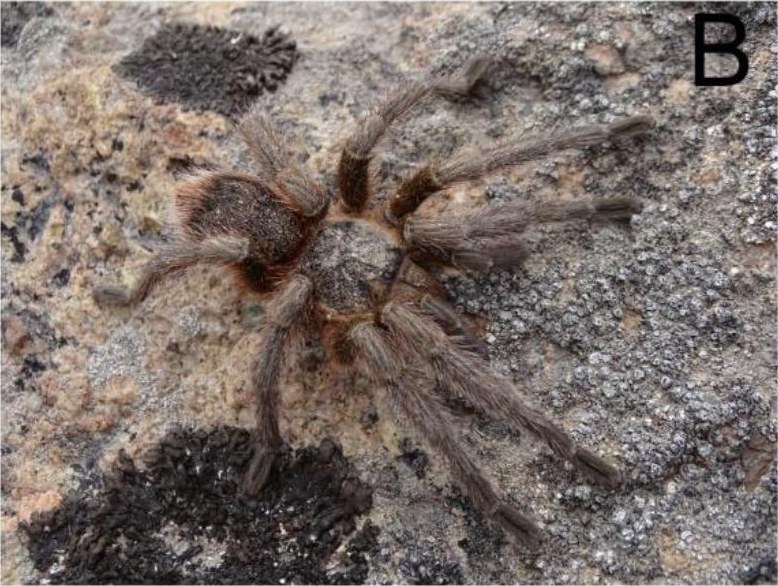 Live specimen © Allegue & Ferretti (2025), male in his habitat
Type Locality and Records
Original Description
Distribution
Type Locality: Villa Dique Florentino Ameghino, Chubut, Argentina
Adult Male Activity
Collection months of 2 adult male specimen records, against the rainfall where they live
All 2 were collected in October 2022, so the bars show when collecting took place, not when males are active.
Mean monthly rainfall and temperature 2001–2020 near where these males were collected, Argentina. MERRA-2 via NASA POWER, for a grid cell averaging 125 m. Southern hemisphere — seasons are inverted, so December is midsummer.
Etymology
The specific name is a patronym in honor of Florentino Ameghino (1853-1911), a recognized Argentinean scientist, naturalist and evolutionist who made significant contributions in his time, and which also corresponds to the type locality of the specimens found.
Specimen Records (4)
Holotype male of Euathlus ameghinoi; manual capture.
Paratype female of Euathlus ameghinoi; same data as the holotype. Spermathecae figured.
Paratype male of Euathlus ameghinoi; same data as the holotype.
Other material of Euathlus ameghinoi; manual capture.
Taxonomic History
- One of the first two records of Euathlus from the Patagonian Steppe, outside the Andean mountain system in Argentina. Recovered as sister to E. ventus in both the cladistic and COI analyses, the two forming a steppe clade supported by an apical keel on the embolus tip and short barbs on type III urticating setae.