Sandinista lanceolatum (Simon, 1891)
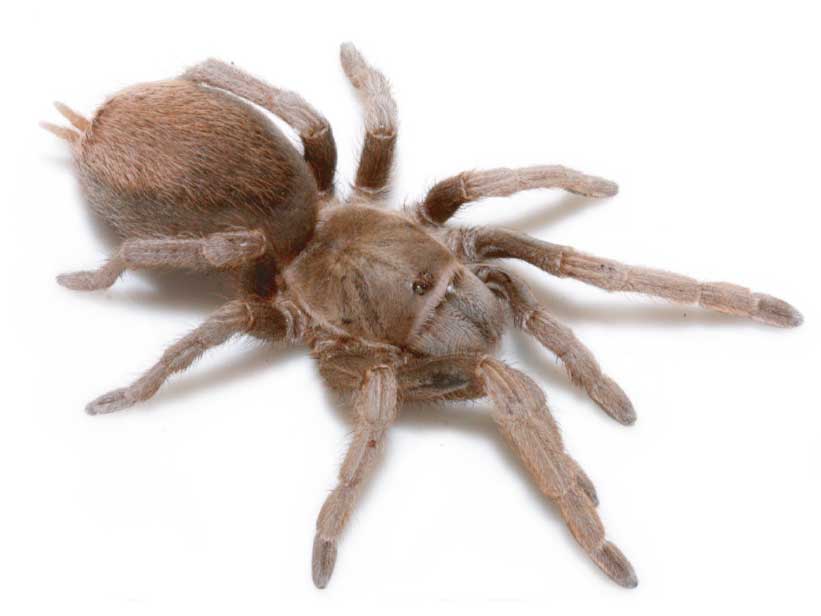 Female
Type Locality and Records
Original Description
Distribution
Type Locality: Nicaragua
Adult Male Activity
Collection months of 5 adult male specimen records, against the rainfall where they live
Of 5 adult males, 1 of 5 (20%) fall in the six wettest months, and 2 of 5 (40%) in the six warmest. Collections peak in January.
Mean monthly rainfall and temperature 2001–2020 near where these males were collected. MERRA-2 via NASA POWER, for a grid cell averaging 93 m. Wet and dry seasons, from the rainfall at the locality itself. Records span 2 countries (Costa Rica, Nicaragua), so one climate curve cannot describe all of them.
Synonyms
Specimen Records (9)
Holotype male of Brachypelma fossorium Valerio, 1980, now a junior synonym of Sandinista lanceolatum. At 32.8 mm the largest male examined by Longhorn & Gabriel (2019), who figure its palpal bulb (figs. 13-14). The July collection date is out of step with the October-December wandering season reported for Nicaraguan males; the authors suggest either a disjunct breeding season at the southern end of the range or simply longer persistence of wandering males there.
Holotype male of Eurypelma lanceolatum Simon, 1891, in the Museum national d'Histoire naturelle, Paris. The label reads "Pack"; the original description gives "Peckham" as collector, which may refer to G. W. and/or E. G. Peckham, though Longhorn & Gabriel (2019) found nothing to indicate either travelled in Nicaragua and suspect the specimens came from a prior, unknown source. Carapace length 11.9, width 9.3; total preserved length >17.8 mm with abdomen, spinnerets and tibia-tarsus of leg IV missing. Redescribed and figured by Longhorn & Gabriel (2019, figs. 1-14). Two further specimens in the same jar, labelled as allotype females, are immatures of other species - probably Aphonopelma seemanni and A. crinirufum.
Allotype female of Brachypelma fossorium Valerio, 1980. On the synonymy of fossorium with Sandinista lanceolatum, Longhorn & Gabriel (2019) note this is the first female of that species ever described, Simon's two 1891 "allotypes" being misidentified immatures of other genera. Total length including chelicerae 40.1 mm. Its spermathecae are figured (figs. 15-16) and show a transverse undulation rather than the anterior notch Valerio diagnosed Brachypelma on.
Female of Sandinista lanceolatum, INBio 71310 (INB0004325226), leg./det. C. Viquez, confirmed by J. Mendoza and examined in 2016. Not personally examined by Longhorn & Gabriel (2019). A second unknown specimen is listed under the same collection code, INB0003538964.
Male of Sandinista lanceolatum deposited at INBio; not personally examined by Longhorn & Gabriel (2019), who list it for its geographical value, and note the accession is unknown.
Non-type male of Sandinista lanceolatum, Stuart John Longhorn Collection (THFOS2). Total length including chelicerae 24.5 mm. Figured alive by Longhorn & Gabriel (2019, fig. 21 lower).
Non-type female of Sandinista lanceolatum, Stuart John Longhorn Collection (THFOS3). Total length including chelicerae 37.9 mm; described in full by Longhorn & Gabriel (2019) as the non-type female and figured alive (fig. 19).
Non-type male of Sandinista lanceolatum, Stuart John Longhorn Collection (THFOS1). Total length including chelicerae 29.4 mm, the largest Nicaraguan male examined; described in full by Longhorn & Gabriel (2019) as the non-type male and figured alive (fig. 21 upper).
Four non-type males of Sandinista lanceolatum, Stuart John Longhorn Collection. Coordinates approximate. This series alone shows substantial size variation between mature males, the smallest only 22.7 mm. Day of collection not recorded.
Taxonomic History
- 1891 Eurypelma lanceolatum Simon, 1891 - described from a single male labelled no more precisely than "Nicaragua", in a list of the Aviculariidae of Mexico and Central America. Simon also assigned two females to the species; Longhorn & Gabriel (2019) found both to be immatures of other things, one probably Aphonopelma seemanni and the other probably A. crinirufum, both of which are sympatric and often syntopic with this spider.
- The name then drifted. Petrunkevitch (1939) called Eurypelma a "genus incertum et invalidum" but carried on listing species under it, as did Roewer (1942). Raven (1985) made Avicularia a senior synonym of Eurypelma, which implicitly swept a great many unrevised names into Avicularia. Schmidt (1993) relisted lanceolatum in Aphonopelma Pocock, 1901 alongside a batch of other transfers, with no explanation and no apparent examination of the specimens.
- 2019 Longhorn & Gabriel (2019) re-examined the holotype at the MNHN and erected the monotypic genus Sandinista for it, Sandinista lanceolatum (Simon, 1891) comb. nov. Their case rests on the male palpal bulb: a broad embolus that tapers gradually to the apex without the proximal constriction seen in Brachypelma, keels that are neither denticulate nor serrate, and prolateral PI and SA keels that are kinked and almost sinuous, diverging distally to leave a smooth depressed lanceolate region. They place it near Aphonopelma sensu stricto, Sphaerobothria and Stichoplastoris. The genus is named for the Frente Sandinista de Liberacion Nacional and Augusto Cesar Sandino, and also for The Clash album; it is treated as neuter.
- In the same paper Brachypelma fossorium Valerio, 1980 became a junior synonym. Valerio had diagnosed Brachypelma partly on a spermatheca with a shallow notch in the anterior edge; re-examining his allotype, Longhorn & Gabriel found not a notch but a transverse undulation whose apparent depth changes with viewing angle, and treat the variation between females as intraspecific. They read the gross resemblance of the bulb to Brachypelma and Sericopelma as functional convergence tied to similarly low-fused spermathecae rather than as evidence of relationship. This removes the last of Valerio's three Costa Rican "Brachypelma" from that genus - the other two had already gone to Sericopelma and Megaphobema (Gabriel & Longhorn 2015).
- That has a practical consequence the authors spell out: every Brachypelma is on CITES Appendix II, so this species was protected under a name it no longer holds. They recommend it be removed from the listing rather than listed in its own right, judging the trade in it small and not persistent - under 500 animals into the hobby as of early 2018.
- The allotype female of fossorium (MIUCR-126) is, on this synonymy, the first female of S. lanceolatum ever described, since Simon's two were misidentified.