Acanthoscurria cordubensis Thorell, 1894
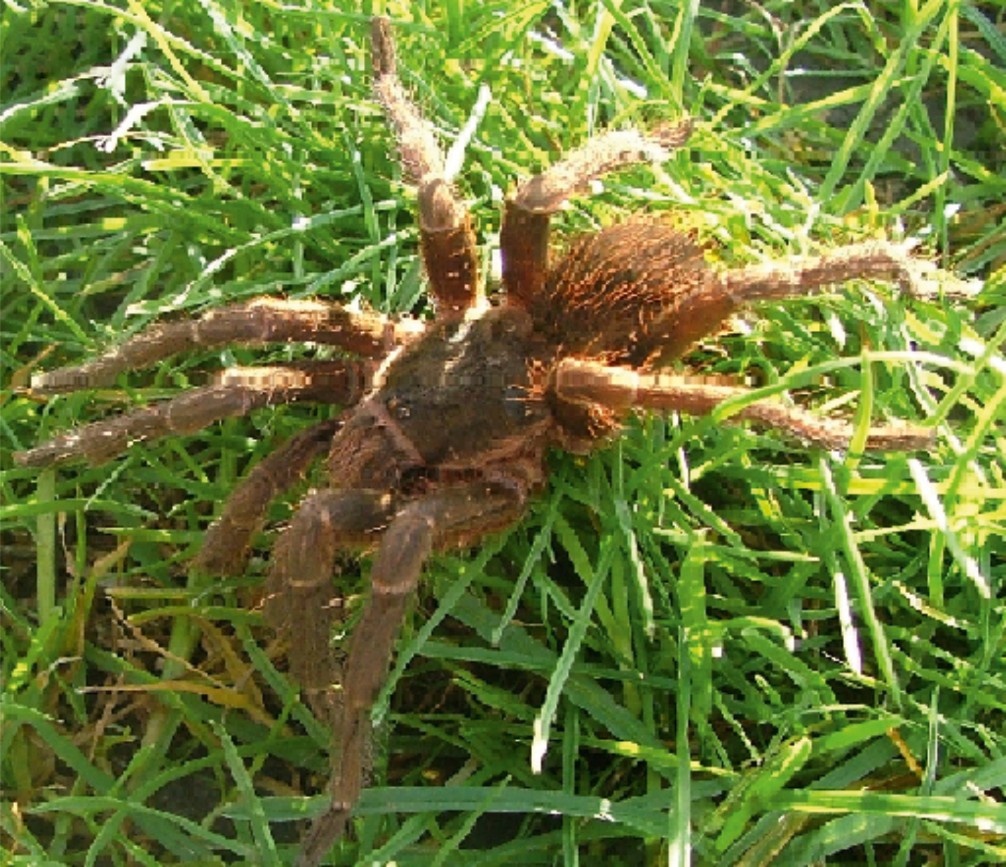 Live specimen © Ray Gabriel, in Gabriel (2020a) fig. 13B - a living male of the light form, in grass. Arachnology 18(5), © British Arachnological Society
Type Locality and Records
Original Description
Distribution
Type Locality: Near Córdoba, Argentina ("ad Cordubam Reipublicae Argentinae")
Adult Male Activity
Collection months of 4 adult male specimen records, against the rainfall where they live
Mean monthly rainfall and temperature 2001–2020 near where these males were collected. MERRA-2 via NASA POWER, for a grid cell averaging 121 m. Southern hemisphere — seasons are inverted, so December is midsummer. Records span 3 countries (Argentina, Paraguay, Uruguay), so one climate curve cannot describe all of them.
Etymology
From Corduba, the Latin name of Córdoba - "of Córdoba", after the Argentine city near which the holotype was taken. Thorell's own locality line reads "ad Cordubam Reipublicae Argentinae". He does not state the derivation.
Synonyms
Specimen Records (16)
Holotype male of Acanthoscurria bollei Schmidt, 2005, a junior synonym of A. cordubensis (Gabriel 2020a); deposited in the Senckenberg Museum, Frankfurt - the catalogue number is not published. Schmidt writes "Depto. Maldonado, Minas", but Minas is the capital of Lavalleja department, next to Maldonado; coordinates are the town of Minas. Body 26 mm, carapace 14 x 12 mm.
Holotype male of Acanthoscurria cordubensis Thorell, 1894, in the Swedish Museum of Natural History, Stockholm. Thorell had it "many years" before 1894 from Prof. Weyenbergh (Weijenbergh) of Córdoba, taken "ad Cordubam" - near the city; no date. Thorell measured it at 33 mm (36.5 with chelicerae), carapace 18 x 15 mm; Gabriel (2020a) re-measured the carapace at 15.6 x 14.0. Coordinates are the city of Córdoba.
Holotype female of Acanthoscurria suina Pocock, 1903, a junior synonym of A. cordubensis (Gabriel 2020a). Pocock gives only "Loc. Uruguay". 1878 is the year of the museum registration number, not a collection date. Carapace 19 x 16.5 mm (Pocock 1903); Gabriel re-measured it at 19.4 x 15.8.
Holotype male of Acanthoscurria borealis Schmidt & Peters, 2005, a junior synonym of A. cordubensis (Gabriel 2020a). Not a wild-caught record: one of about a dozen spiders bought by H.-J. Peters from a shipment said to come from Guatemala, it matured in captivity and died at the end of March 2005; "April 2005" in the catalogues is when it reached Schmidt. Gabriel considers the Guatemalan origin a dealer's error - shipments from Paraguay and Guatemala reached importers in the same week - and no Acanthoscurria is otherwise known from Central America.
Paratype male of Acanthoscurria bollei Schmidt, 2005, a junior synonym of A. cordubensis. Schmidt (2005g) had two males, the holotype from Uruguay and this one from Argentina; the SMF number is from the Senckenberg type database as cited by the World Spider Catalog. Coordinates are the hamlet of San Cipriano.
Paratype female of Acanthoscurria borealis, a junior synonym of A. cordubensis; from the same pet-trade stock as the holotype, sent to Schmidt in April 2005 (not a collection date). Not adult when described (body 34 mm).
Two males and one female, collected 21 August 1913 by A. Fischer; identified as A. bollei by D. Harrow, re-determined A. cordubensis by R. Gabriel, 30 April 2013. Coordinates are the town of San Bernardino.
Non-type female of Acanthoscurria cordubensis, det. R. Gabriel 5 July 2024.
Non-type male of Acanthoscurria cordubensis, det. R. Gabriel 5 July 2024.
Non-type male of Acanthoscurria cordubensis, det. R. Gabriel 5 July 2024.
Non-type male of Acanthoscurria cordubensis, det. R. Gabriel 5 July 2024.
One male and one female; non-type material of Acanthoscurria cordubensis, donated to the Oxford museum by F. Pérez-Miles. Sherwood et al. (2025) give the date as 04/2009, Gabriel (2020a) as May 2009; April is kept, as the later citation.
Non-type male of Acanthoscurria cordubensis, det. R. Gabriel 27 October 2023.
Three males, collected by A. Fischer in 1912-1914 (the label gives no single year, so none is entered); identified as A. bollei by Harms on 7 April 2005 - the date previously entered here as a collection date. Re-determined A. cordubensis (Gabriel 2020a). Coordinates are the town of San Bernardino.
Two males; non-type material of Acanthoscurria cordubensis, det. R. Gabriel 5 September 2013.
Male in the Simon collection, Paris, determined by Simon (1892) as Acanthoscurria minor and since used as the reference specimen for that name. Gabriel (2020a) re-identified it from photographs as A. cordubensis by its bulb and apophyses. The label says Guyana (French Guiana), thousands of kilometres from any other record; Gabriel notes another Simon specimen with similarly doubtful data, so no country or coordinates are entered.
Genitalia
Taxonomic History
- 1894 Acanthoscurria cordubensis Thorell, 1894 - described from a single male taken near Córdoba, Argentina, and given to Thorell "many years" earlier by Prof. Weyenbergh. The holotype is NHRS 000006196 in Stockholm. Thorell separated it from every Acanthoscurria then described by its first and fourth legs being equally long.
- 1903 Pocock (1903) described Acanthoscurria suina from a single female from Uruguay (BMNH 1878.23).
- 1964 Schiapelli & Gerschman (1964), revising the Argentine Acanthoscurria, redescribed A. cordubensis from a topotypic male in Paris and a female from Santa Fe, without seeing the holotype. They redescribed A. suina from Argentine material, described its male, and told the two apart by how convex the sternum is.
- 2004 Schmidt (2004) described Acanthoscurria bollei from two small males from Uruguay and Entre Ríos, and its female later the same year - both nomina nuda, with no type depository.
- 2005 Schmidt & Peters (2005) described Acanthoscurria borealis, "the first Acanthoscurria from Central America", from pet-trade animals said to come from Guatemala - also a nomen nudum.
- 2005 Schmidt (2005) republished both with types in the Senckenberg, making A. bollei Schmidt, 2005 and A. borealis Schmidt & Peters, 2005 available names.
- 2020 Gabriel (2020) examined the holotype, redescribed the species and made A. suina, A. bollei and A. borealis junior synonyms. The sternum's convexity varies within a single series, so it does not separate species; the Guatemalan origin of borealis he considered a dealer's error. He also judged that the male Simon (1892) identified as A. minor (MNHN AR 4785, labelled Guyana) belongs here.
- 2025 Sherwood et al. (2025) examined the types again and listed the species' museum material.