Acanthoscurria geniculata (Koch, 1841)
Common name: Giant White Knee
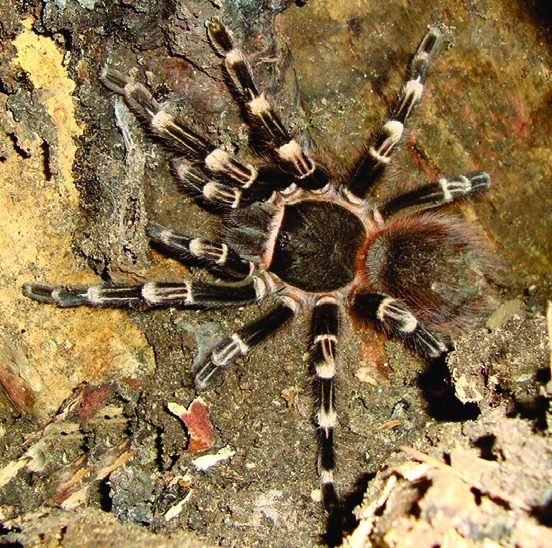 Live specimen © Roberto P. Moraes, in Paula et al. (2014) fig. 2 - a living female at Belterra, Pará (IBSP 151505). Zoologia 31(1), CC BY-NC
Type Locality and Records
Original Description
Distribution
Type Locality: America (Koch 1841); the holotype is labelled Rio Branco, Roraima, Brazil
Adult Male Activity
Collection months of 39 adult male specimen records, against the rainfall where they live
Of 39 adult males, 16 of 39 (41%) fall in the six wettest months, and 31 of 39 (79%) in the six warmest. Collections peak in November. The warmer half of the year is much the closer fit here.
Mean monthly rainfall and temperature 2001–2020 near where these males were collected, Brazil. MERRA-2 via NASA POWER, for a grid cell averaging 186 m. Wet and dry seasons, from the rainfall at the locality itself.
Etymology
Latin geniculatus, "having knees" or "jointed", from geniculum, a little knee - evidently for the broad pale bands at the joints of the legs, which Koch put in the first line of his diagnosis ("at the joint-tips of the legs a reddish-white patch"). Koch does not state the derivation. The common name "whiteknee" follows the same feature.
Pronunciation
Acanthoscurria (uh-kan-thuh-SKOOR-ee-uh)
Synonyms
Specimen Records (81)
Holotype male of Acanthoscurria transamazonica Piza, 1972, a junior synonym of A. geniculata (Paula et al. 2014). Collected on the Trans-Amazonian Highway at Marabá in January 1972 by Professors Guido Ranzani and Moacyr Camponez do Brasil Sobrinho, and deposited by Piza in the Departamento de Zoologia of the Escola Superior de Agricultura "Luiz de Queiroz", Piracicaba (MZLQ A0092 in the World Spider Catalog). It later passed to the Instituto Butantan as IBSP 138248, where Paula et al. examined it before it was destroyed in the 2010 fire. Body 60 mm, carapace 29 x 26 mm, legs I 92 and IV 94 mm (Piza 1972).
Re-examined and figured by Sherwood, Gabriel, Peñaherrera-R. & Alayón García (2025) as the exemplar of Acanthoscurria sensu stricto. Koch (1841) gives only "Klug. Königliche Sammlung in Berlin" and "Vaterland. Amerika"; the Rio Branco and Natterer data are from the specimen's label as reported by Paula et al. (2014).
Collected XI.1961 by A. R. Hoge (Paula et al. 2014); previously entered as 1960.
Paula et al. (2014) list two males under this number.
XI.1988 (Paula et al. 2014); previously entered as December.
11.VII.1991 (Paula et al. 2014); previously entered as December.
One of four females, VII.1999, P. Gnaspini (Paula et al. 2014); previously entered as December.
One of four females, VII.1999, P. Gnaspini (Paula et al. 2014); previously entered as December.
One of four females, VII.1999, P. Gnaspini (Paula et al. 2014); previously entered as December.
One of four females, VII.1999, P. Gnaspini (Paula et al. 2014); previously entered as December.
VIII.1999, P. Gnaspini (Paula et al. 2014); previously entered as December.
Four males under one number (Paula et al. 2014).
Part of a lot of two females and four males collected by A. P. Silva between 27 November and 25 December 2009 (Paula et al. 2014); the paper gives the range for the whole lot, so no month or day is entered. Previously each specimen carried an exact day taken from one end of the range.
Part of a lot of two females and four males collected by A. P. Silva between 27 November and 25 December 2009 (Paula et al. 2014); the paper gives the range for the whole lot, so no month or day is entered. Previously each specimen carried an exact day taken from one end of the range.
Part of a lot of two females and four males collected by A. P. Silva between 27 November and 25 December 2009 (Paula et al. 2014); the paper gives the range for the whole lot, so no month or day is entered. Previously each specimen carried an exact day taken from one end of the range.
Part of a lot of two females and four males collected by A. P. Silva between 27 November and 25 December 2009 (Paula et al. 2014); the paper gives the range for the whole lot, so no month or day is entered. Previously each specimen carried an exact day taken from one end of the range.
The male Paula et al. (2014) described and figured (figs 3-7; the female description and figs 8-9 carry the same number, apparently a slip). Part of a lot of two females and four males collected by A. P. Silva between 27 November and 25 December 2009; no single date is given, so none is entered.
The female photographed alive for fig. 2 of Paula et al. (2014).
Sex not stated in Paula et al. (2014).
The male photographed alive for fig. 1 of Paula et al. (2014).
Sex not stated in Paula et al. (2014).
The female Pickard-Cambridge (1896) described for the first time, taken by himself during the Faraday expedition up the Amazon: she flicked urticating hairs at him before he caught her. Registration 1896.12.13.1 is the Faraday accession (A. brocklehursti, from the same voyage, is 1896.12.13.2). Sherwood et al. (2025) list the collector as A. M. Moss; Pickard-Cambridge says he took it himself. Previously entered as a male from Belterra. Coordinates are the town of Santarém.
One of five specimens (IBSP 107713, 107022, 107023, 107691, 107778) collected by the Butantan team at the Tucuruí dam between 1984 and 1996 (Paula et al. 2014); no single year is given, so none is entered. The paper counts four females and one male among the five without saying which is the male, so the sexes on these records are unconfirmed.
One of five specimens (IBSP 107713, 107022, 107023, 107691, 107778) collected by the Butantan team at the Tucuruí dam between 1984 and 1996 (Paula et al. 2014); no single year is given, so none is entered. The paper counts four females and one male among the five without saying which is the male, so the sexes on these records are unconfirmed.
One of five specimens (IBSP 107713, 107022, 107023, 107691, 107778) collected by the Butantan team at the Tucuruí dam between 1984 and 1996 (Paula et al. 2014); no single year is given, so none is entered. The paper counts four females and one male among the five without saying which is the male, so the sexes on these records are unconfirmed.
One of five specimens (IBSP 107713, 107022, 107023, 107691, 107778) collected by the Butantan team at the Tucuruí dam between 1984 and 1996 (Paula et al. 2014); no single year is given, so none is entered. The paper counts four females and one male among the five without saying which is the male, so the sexes on these records are unconfirmed.
One of five specimens (IBSP 107713, 107022, 107023, 107691, 107778) collected by the Butantan team at the Tucuruí dam between 1984 and 1996 (Paula et al. 2014); no single year is given, so none is entered. The paper counts four females and one male among the five without saying which is the male, so the sexes on these records are unconfirmed.
Non-type male of Acanthoscurria geniculata.
Non-type male of Acanthoscurria geniculata.
Non-type male of Acanthoscurria geniculata, det. R. Gabriel 27 October 2023.
Five males, "Riobranco, coll. Matteu", determined by Ausserer (Sherwood et al. 2025). No year is given; the 1896 and "Acre" previously entered here are in no source. The Rio Branco here is probably the river in Roraima, where Natterer collected for Vienna, rather than the city in Acre - Pickard-Cambridge (1896) already suspected Ausserer worked from "Natterer's specimen from the Rio Branco".
Genitalia
Taxonomic History
- 1841 Mygale geniculata C. L. Koch, 1841 - described from a single male in the royal collection at Berlin, "a very rarely occurring species, of which only the male is known so far", its homeland given only as "America". The holotype is ZMB 2055, labelled Rio Branco, Roraima, J. Natterer.
- 1850 Koch (1850) placed it in his genus Scurria.
- 1871 Ausserer (1871) moved it to Acanthoscurria, of which it is the type species.
- 1896 Pickard-Cambridge (1896) described the female for the first time, from a specimen he took himself from a hollow fallen branch near Santarém - and recorded her flicking urticating hairs, which he believed no one had described before.
- 1972 Piza (1972) described Acanthoscurria transamazonica from a male from Marabá, Pará - "the first theraphosid described from the Transamazônica", the new Trans-Amazonian Highway, collected there in January 1972. Piza thought it the largest theraphosid yet found in Brazil.
- 2014 Paula et al. (2014), revising the Brazilian Amazonian Acanthoscurria, redescribed both sexes from more than 70 museum specimens and made A. transamazonica a junior synonym. Its holotype, which they had examined, was destroyed in the 2010 fire at the Instituto Butantan.
- 2025 Sherwood et al. (2025) photographed the holotype as the exemplar of Acanthoscurria in the strict sense, against their new theraphosoides species-group.