Acanthoscurria gomesiana Mello-Leitão, 1923
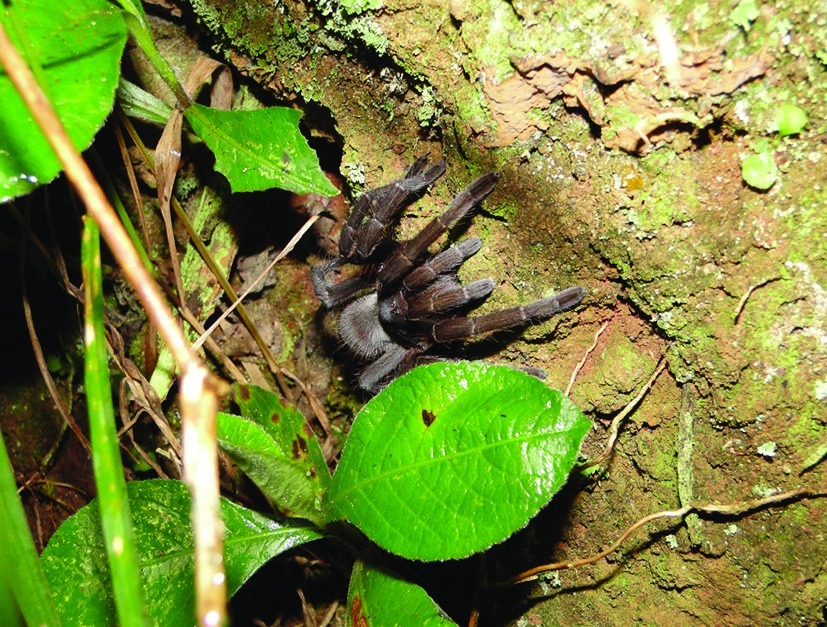 Live specimen © Rafael P. Indicatti, in Gonzalez-Filho et al. (2012) fig. 4a - a female beside her burrow at Trilha da Gruta, Socorro, São Paulo, waiting for prey (IBSP 110998). International Journal of Zoology, CC BY 3.0
Type Locality and Records
Original Description
Distribution
Type Locality: São Paulo, Brazil - Butantã (the specimens J. F. Gomes gave) and Ipiranga (those in the Museu Paulista)
Adult Male Activity
Collection months of 84 adult male specimen records, against the rainfall where they live
Of 84 adult males, 24 of 84 (29%) fall in the six wettest months, and 24 of 84 (29%) in the six warmest. Collections peak in April.
Mean monthly rainfall and temperature 2001–2020 near where these males were collected, Brazil. MERRA-2 via NASA POWER, for a grid cell averaging 621 m. Southern hemisphere — seasons are inverted, so December is midsummer.
Etymology
For Dr. João Florencio Gomes, the Brazilian herpetologist who worked at Butantan, "recently deceased, who discovered the species" (Mello-Leitão 1923). The specimens Gomes gave Mello-Leitão were caught at Butantan, and the whole of Theraphosideas do Brasil is dedicated to his memory.
Synonyms
Specimen Records (170)
Lectotype of Acanthoscurria gomesiana, designated by Gonzalez-Filho et al. (2012): the only one of Mello-Leitão's syntypes they could find, with a label in his hand reading "typus, São Paulo". Mello-Leitão named no holotype; Schiapelli & Gerschman (1964) wrongly cited one. Destroyed in the Museu Nacional fire of 2018. The Museu Nacional's own database (World Spider Catalog, 2019) listed MNRJ 00049 as three male paratypes and a female, MNRJ 00029, as the holotype - which cannot be right for a species described from males; both were lost in the same fire.
Holotype male of Acanthoscurria aurita Piza, 1939, a junior synonym (Gonzalez-Filho et al. 2012), who examined it. The World Spider Catalog records it as MZLQ A0040, in the Luiz de Queiroz collection at Piracicaba, from which it passed to the Instituto Butantan. Coordinates are Piracicaba, as given in the same paper.
Holotype male of Acanthoscurria pugnax Vellard, 1924, a junior synonym (Gonzalez-Filho et al. 2012). They looked for it in the Instituto Vital Brazil and could not find it; the Museu Nacional database lists it as MNRJ 14002, destroyed in the 2018 fire.
Holotype female of Acanthoscurria violacea Mello-Leitão, 1923, a junior synonym (Gonzalez-Filho et al. 2012); not located in the Museu de Zoologia, São Paulo.
Examined by Gonzalez-Filho et al. (2012).
Examined by Gonzalez-Filho et al. (2012).
Examined by Gonzalez-Filho et al. (2012).
Examined by Gonzalez-Filho et al. (2012).
Examined by Gonzalez-Filho et al. (2012).
The paper gives IBSP 11027 to two different specimens, from Capitão Andrade and from Frutal. Examined by Gonzalez-Filho et al. (2012).
Listed under São Paulo in the paper, but its coordinates are in Minas Gerais, where there is a Vargem Alegre; entered as Minas Gerais. Examined by Gonzalez-Filho et al. (2012).
Examined by Gonzalez-Filho et al. (2012).
Examined by Gonzalez-Filho et al. (2012).
Examined by Gonzalez-Filho et al. (2012).
Examined by Gonzalez-Filho et al. (2012).
Examined by Gonzalez-Filho et al. (2012).
Examined by Gonzalez-Filho et al. (2012).
Examined by Gonzalez-Filho et al. (2012).
Examined by Gonzalez-Filho et al. (2012).
Examined by Gonzalez-Filho et al. (2012).
Examined by Gonzalez-Filho et al. (2012).
Examined by Gonzalez-Filho et al. (2012).
Examined by Gonzalez-Filho et al. (2012).
Examined by Gonzalez-Filho et al. (2012).
Examined by Gonzalez-Filho et al. (2012).
Examined by Gonzalez-Filho et al. (2012).
Examined by Gonzalez-Filho et al. (2012).
Examined by Gonzalez-Filho et al. (2012).
Examined by Gonzalez-Filho et al. (2012).
Examined by Gonzalez-Filho et al. (2012).
Examined by Gonzalez-Filho et al. (2012).
Examined by Gonzalez-Filho et al. (2012).
Examined by Gonzalez-Filho et al. (2012).
Examined by Gonzalez-Filho et al. (2012).
Examined by Gonzalez-Filho et al. (2012).
Examined by Gonzalez-Filho et al. (2012).
Examined by Gonzalez-Filho et al. (2012).
Examined by Gonzalez-Filho et al. (2012).
Examined by Gonzalez-Filho et al. (2012).
Examined by Gonzalez-Filho et al. (2012).
Examined by Gonzalez-Filho et al. (2012).
Examined by Gonzalez-Filho et al. (2012).
Examined by Gonzalez-Filho et al. (2012).
Examined by Gonzalez-Filho et al. (2012).
Examined by Gonzalez-Filho et al. (2012).
Examined by Gonzalez-Filho et al. (2012).
Examined by Gonzalez-Filho et al. (2012).
Examined by Gonzalez-Filho et al. (2012).
Examined by Gonzalez-Filho et al. (2012).
Examined by Gonzalez-Filho et al. (2012).
Examined by Gonzalez-Filho et al. (2012).
Examined by Gonzalez-Filho et al. (2012).
Examined by Gonzalez-Filho et al. (2012).
Examined by Gonzalez-Filho et al. (2012).
Examined by Gonzalez-Filho et al. (2012).
Examined by Gonzalez-Filho et al. (2012).
Examined by Gonzalez-Filho et al. (2012).
Examined by Gonzalez-Filho et al. (2012).
Examined by Gonzalez-Filho et al. (2012).
Examined by Gonzalez-Filho et al. (2012).
Examined by Gonzalez-Filho et al. (2012).
Examined by Gonzalez-Filho et al. (2012).
Examined by Gonzalez-Filho et al. (2012).
Examined by Gonzalez-Filho et al. (2012).
Examined by Gonzalez-Filho et al. (2012).
Examined by Gonzalez-Filho et al. (2012).
Examined by Gonzalez-Filho et al. (2012).
Examined by Gonzalez-Filho et al. (2012).
Examined by Gonzalez-Filho et al. (2012).
Examined by Gonzalez-Filho et al. (2012).
Examined by Gonzalez-Filho et al. (2012).
Examined by Gonzalez-Filho et al. (2012).
Examined by Gonzalez-Filho et al. (2012).
Examined by Gonzalez-Filho et al. (2012).
Examined by Gonzalez-Filho et al. (2012).
Examined by Gonzalez-Filho et al. (2012).
Examined by Gonzalez-Filho et al. (2012).
Examined by Gonzalez-Filho et al. (2012).
Examined by Gonzalez-Filho et al. (2012).
Examined by Gonzalez-Filho et al. (2012).
Examined by Gonzalez-Filho et al. (2012).
Examined by Gonzalez-Filho et al. (2012).
Examined by Gonzalez-Filho et al. (2012).
Examined by Gonzalez-Filho et al. (2012).
Examined by Gonzalez-Filho et al. (2012).
Examined by Gonzalez-Filho et al. (2012).
Examined by Gonzalez-Filho et al. (2012).
Examined by Gonzalez-Filho et al. (2012).
Examined by Gonzalez-Filho et al. (2012).
Examined by Gonzalez-Filho et al. (2012).
Examined by Gonzalez-Filho et al. (2012).
Collected 22–24.IX.1997. Examined by Gonzalez-Filho et al. (2012).
Examined by Gonzalez-Filho et al. (2012).
Examined by Gonzalez-Filho et al. (2012).
Examined by Gonzalez-Filho et al. (2012).
Examined by Gonzalez-Filho et al. (2012).
Examined by Gonzalez-Filho et al. (2012).
Examined by Gonzalez-Filho et al. (2012).
Examined by Gonzalez-Filho et al. (2012).
Examined by Gonzalez-Filho et al. (2012).
Examined by Gonzalez-Filho et al. (2012).
Examined by Gonzalez-Filho et al. (2012).
Examined by Gonzalez-Filho et al. (2012).
Examined by Gonzalez-Filho et al. (2012).
Examined by Gonzalez-Filho et al. (2012).
Examined by Gonzalez-Filho et al. (2012).
Examined by Gonzalez-Filho et al. (2012).
Examined by Gonzalez-Filho et al. (2012).
Examined by Gonzalez-Filho et al. (2012).
Examined by Gonzalez-Filho et al. (2012).
The male photographed alive for fig. 1a. Examined by Gonzalez-Filho et al. (2012).
Examined by Gonzalez-Filho et al. (2012).
Examined by Gonzalez-Filho et al. (2012).
Examined by Gonzalez-Filho et al. (2012).
Examined by Gonzalez-Filho et al. (2012).
Examined by Gonzalez-Filho et al. (2012).
Examined by Gonzalez-Filho et al. (2012).
Examined by Gonzalez-Filho et al. (2012).
Examined by Gonzalez-Filho et al. (2012).
Examined by Gonzalez-Filho et al. (2012).
Examined by Gonzalez-Filho et al. (2012).
Examined by Gonzalez-Filho et al. (2012).
Examined by Gonzalez-Filho et al. (2012).
Examined by Gonzalez-Filho et al. (2012).
Examined by Gonzalez-Filho et al. (2012).
The paper gives IBSP 11027 to two different specimens, from Capitão Andrade and from Frutal. Examined by Gonzalez-Filho et al. (2012).
Examined by Gonzalez-Filho et al. (2012).
Examined by Gonzalez-Filho et al. (2012).
Examined by Gonzalez-Filho et al. (2012).
Examined by Gonzalez-Filho et al. (2012).
Examined by Gonzalez-Filho et al. (2012).
Examined by Gonzalez-Filho et al. (2012).
Examined by Gonzalez-Filho et al. (2012).
Examined by Gonzalez-Filho et al. (2012).
Examined by Gonzalez-Filho et al. (2012).
Examined by Gonzalez-Filho et al. (2012).
Examined by Gonzalez-Filho et al. (2012).
Examined by Gonzalez-Filho et al. (2012).
Examined by Gonzalez-Filho et al. (2012).
Examined by Gonzalez-Filho et al. (2012).
Examined by Gonzalez-Filho et al. (2012).
Examined by Gonzalez-Filho et al. (2012).
Examined by Gonzalez-Filho et al. (2012).
The male photographed in threat display for fig. 5f. Examined by Gonzalez-Filho et al. (2012).
Examined by Gonzalez-Filho et al. (2012).
Examined by Gonzalez-Filho et al. (2012).
Examined by Gonzalez-Filho et al. (2012).
Examined by Gonzalez-Filho et al. (2012).
Examined by Gonzalez-Filho et al. (2012).
Examined by Gonzalez-Filho et al. (2012).
Examined by Gonzalez-Filho et al. (2012).
Examined by Gonzalez-Filho et al. (2012).
Examined by Gonzalez-Filho et al. (2012).
Examined by Gonzalez-Filho et al. (2012).
Examined by Gonzalez-Filho et al. (2012).
Examined by Gonzalez-Filho et al. (2012).
Examined by Gonzalez-Filho et al. (2012).
Examined by Gonzalez-Filho et al. (2012).
Examined by Gonzalez-Filho et al. (2012).
Examined by Gonzalez-Filho et al. (2012).
Examined by Gonzalez-Filho et al. (2012).
Collected 03–25.I.2008. Examined by Gonzalez-Filho et al. (2012).
Examined by Gonzalez-Filho et al. (2012).
Collected 19-26.XII.2010. Two females, the photographed pair of figs 1b-c and 4a-b; one of them was watched waiting beside its burrow. Examined by Gonzalez-Filho et al. (2012).
Fig. 1d of the paper, captioned as a female; the material list gives a male. Examined by Gonzalez-Filho et al. (2012).
Examined by Gonzalez-Filho et al. (2012).
Examined by Gonzalez-Filho et al. (2012).
Examined by Gonzalez-Filho et al. (2012).
Examined by Gonzalez-Filho et al. (2012).
Examined by Gonzalez-Filho et al. (2012).
Genitalia
Taxonomic History
- 1923 Acanthoscurria gomesiana Mello-Leitão, 1923 - described from several males from São Paulo, from Butantã (collected by J. F. Gomes) and Ipiranga (in the Museu Paulista), without choosing a holotype. In the same monograph he described three names now sunk in this one: Cyrtopholis zorodes, Phormictopus pheopygus and Acanthoscurria violacea, all from females.
- 1924 Vellard (1924) described Acanthoscurria pugnax from a male from Vila de Fortaleza, Minas Gerais.
- 1939 Piza (1939) described Acanthoscurria aurita from a male from Piracicaba, São Paulo.
- 1964 Schiapelli & Gerschman (1964) redescribed A. gomesiana from the type material, citing a male "holotype", and described the male of A. violacea.
- Bücherl, Timotheo da Costa & Lucas (1971) figured the female type of Cyrtopholis zorodes in their review of Mello-Leitão's types in the Museu Nacional.
- 1983 Lucas (1983) made Phormictopus pheopygus a junior synonym.
- 2012 Gonzalez-Filho et al. (2012) redescribed both sexes and designated the male MNRJ 49 - the only type they could find, labelled "typus" in Mello-Leitão's hand - as lectotype. They made A. violacea, A. pugnax and A. aurita junior synonyms, preferring gomesiana to violacea, published a few pages earlier, as the name with a surviving type and a literature. A. cunhae and A. melanotheria, whose types are lost, they set aside as species inquirendae.
- 2018 Gargiulo, Brescovit & Lucas (2018) made Cyrtopholis zorodes a junior synonym.
- The lectotype and the other types in the Museu Nacional were destroyed in the fire of 2018.