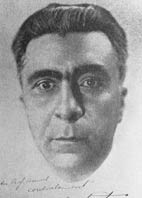
Biography
Cândido Firmino de Mello-Leitão (July 17, 1886 – December 14, 1948) was a Brazilian zoologist who is considered the founder of Arachnology in South America, publishing 198 papers on the taxonomy of Arachnida. He was also involved with education, writing high-school textbooks, and contributed to biogeography, with essays on the distribution of Arachnida in the South American continent.
Cândido Firmino de Mello-Leitão was born on the Cajazeiras Farm, Campina Grande, Paraíba state, Brazil, to Colonel Cândido Firmino and Jacunda de Mello-Leitão. He died in Rio de Janeiro, Brazil. His parents were subsistence farmers, and he had 15 brothers and sisters. He lived most of his childhood at the state of Pernambuco. His first job as a zoologist (1913) was at the Escola Superior de Agricultura e Medicina Veterinária in Piraí, RJ, as a teacher of general Zoology and Systematics. In 1915, he published his first taxonomical paper, with descriptions of some genera and species of spiders from Brazil. He also produced much taxonomic information on the Opiliones, Solifugae, Amblypygi, Uropygi, and smaller orders of arachnids. Mello-Leitão was appointed professor of Zoology at the Museu Nacional, Rio de Janeiro in April 1931, where he remained until December 1937.
Among the many species of spiders researched and catalogued by the zoologist there is one in particular which is very intriguing, given its big size, beauty and carnivore habits (it is a bird eater) – the Lasiodora parahybana. The species was discovered and first described in 1917 in the vicinities of the city of Campina Grande, Paraíba, from where it is endemic. Mello-Leitão received many honor awards and was appointed or elected to distinguished positions during his career. He was president of the Brazilian Academy of Sciences from 1943 to 1945.
On June 6, 1949, his friend Augusto Ruschi inaugurated the Museum of Biology Mello-Leitão in Santa Teresa, Espírito Santo (state). The "Mello-Leitão Award" is granted by the Brazilian Academy of Sciences.
Publication activity
New taxa described
Described Taxa Distribution
35 type localities across 21 genera
Papers (16)
Nuevos aracnidos sudamericanos de las colecciones del Museo de Historia Natural de Montevideo. Comunicaciones Zoologicas del Museo de Historia Natural de Montevideo 2(35): 1-10.
Araneologica varia brasiliana. Anais da Academia Brasileira de Ciências 15: 255-265.
Las arañas de Córdoba, La Rioja, Catamarca, Tucumán, Salta y Jujuy colectadas por los Profesores Birabén. Revta Mus. La Plata (N.S., Zool.) 2: 99-198 [p. 104, pl. II, f. 4 a].
Notas sobre a sistematica das aranhas com descrição de algumas novas especies Sul Ameicanas. Anais da Academia Brasileira de Ciências 13: 103-127.
Spiders of the Guiana forest collected by O. W. Richards. Archos Zool. Est. Sao Paulo 2: 175-197.
Araignées américaines du Musee d'histoire naturelle de Bâle. Rev. suisse zool. 46: 43-93.
Etude sur les arachnides de Papudo et Constitucion (Chili), recueillis par le prof. Dr Carlos E. Porter. Revta chilena Hist. nat. 40: 112-129.
Tres novas aranhas tetrapneumones nas colleccoes do Instituto Butantan. Memorias del Instituto de Butantan 9: 335-360.
Aranhas do Cuminá. Archives of the Museum Nacional. Rio de Janeiro. 32: 51-75.
Aranhas do Pernambuco colhidas por D. Bento Pickel. Anais da Academia Brasileira de Ciências 1: 91-112.
Algumas Theraphosoideas novas do Brasil. Revista do Museu Paulista 14: 307-324.
Theraphosideas do Brasil. Rev. Mus. Paulista 13: 1-438 [p. 306, f. 51-55, 167].
On the genus Lasiodora, C. Koch. Annals and Magazine of Natural History (9) 8: 337-350.
On the genus Grammostola, Simon. Ann. Mag. nat. Hist. (9) 7: 293-305.
An interesting new genus of Aviculariidae. Annals and Magazine of Natural History (9) 6: 141-143.
Notas arachnologicas. 5, Especies novas ou pouco conhecidas do Brasil. Broteria 15: 74-102.