Aenigmarachne colombiana
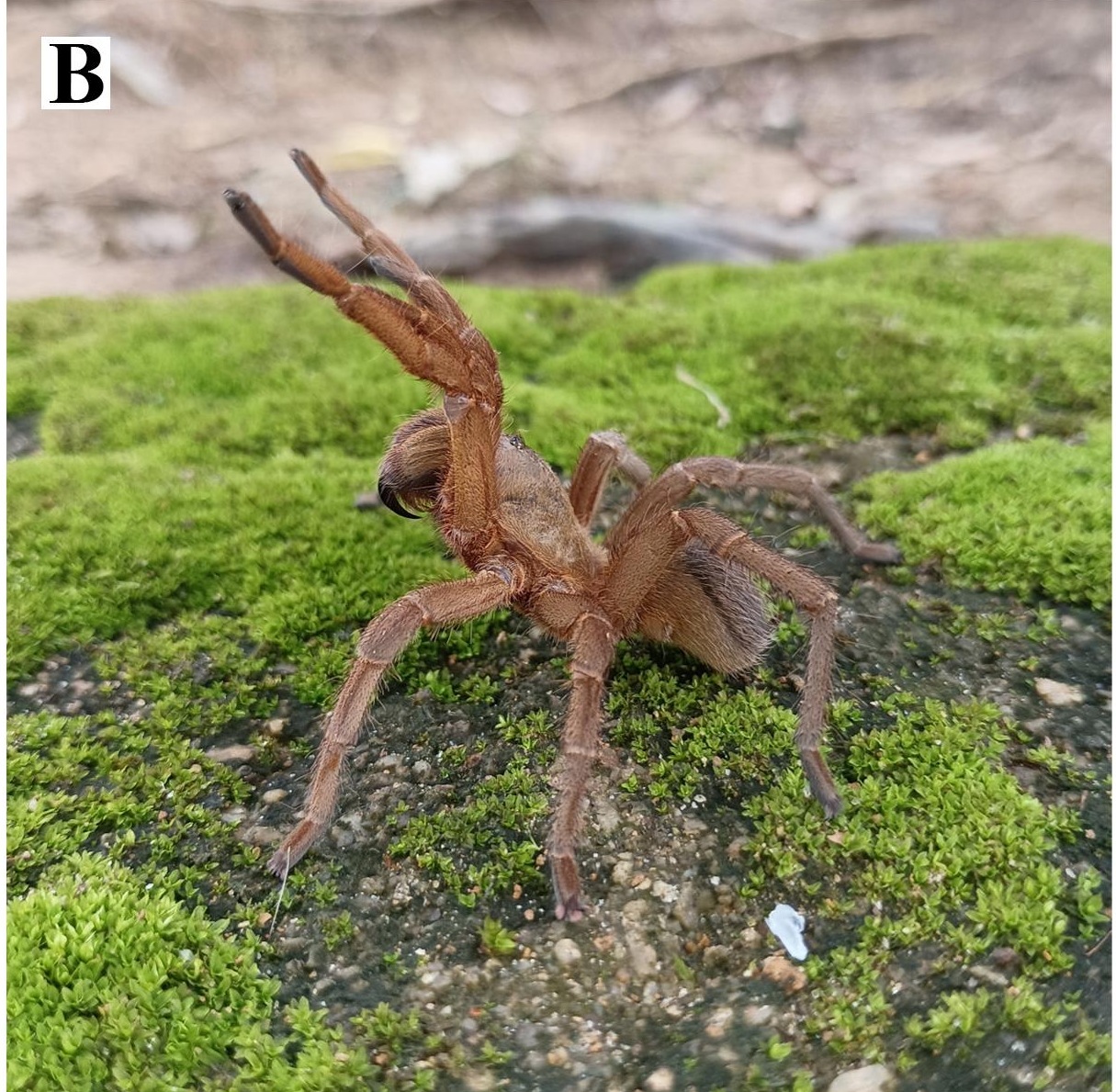 Live specimen © Osorio et al. (2025, fig. 9B) — an adult female in threat posture, in life
Type Locality and Records
Original Description
Distribution
Type Locality: COLOMBIA: Bolívar, Tiquisio, vereda Puerto Coca, 8°29'20"N 74°19'18"W, 30 m
Adult Male Activity
Collection months of 1 adult male specimen record, against the rainfall where they live
Mean monthly rainfall and temperature 2001–2020 near where these males were collected, Colombia. MERRA-2 via NASA POWER, for a grid cell averaging 86 m. Wet and dry seasons, from the rainfall at the locality itself.
Etymology
An adjective referring to Colombia, the country the type specimens came from.
Specimen Records (3)
Holotype male of Aenigmarachne colombiana; hand collected 20-23 December 2020
Paratypes of Aenigmarachne colombiana across four lots: 2 females (ICN-Ar 13745, one dissected, same data as holotype); 1 male (ICN-Ar 13746, December 2017); 1 female (ICN-Ar 13749, 21-25 June 2025, the described female); 1 male and 5 females (ICN-Ar 13750, 21-25 June 2025)
Non-type material of Aenigmarachne colombiana: 1 immature female and 7 juveniles, the basis of the ontogenetic observations on urticating setae
Taxonomic History
- 2025 Aenigmarachne colombiana Osorio, Ávila-Polo, Sabbatino & Suárez-Martínez, 2025
- Only the second species of Aenigmarachne, which had been monotypic since 2005, and the first female described in the genus. It is also the first record of the genus outside Costa Rica — and the Costa Rican record is itself shaky, the holotype of A. sinapophysis being only putatively from Isla del Coco.
- The authors flag their own placement as provisional. The long, thin, tapering embolus, the twin spermathecae and the absence of tibial apophyses all recall Cyclosternum familiare, which leaves two possibilities they intend to resolve elsewhere: either this species moves to Cyclosternum, or C. familiare moves to Aenigmarachne. They keep it here on the most recent available evidence.